Shein Pauses French Retail Expansion After BHV Setback and High-Profile Exits
SGM and Shein’s Partnership Faces Headwinds: Mall management delays new openings amid political criticism, supplier withdrawals, and escalating regulatory pressures on the business model.
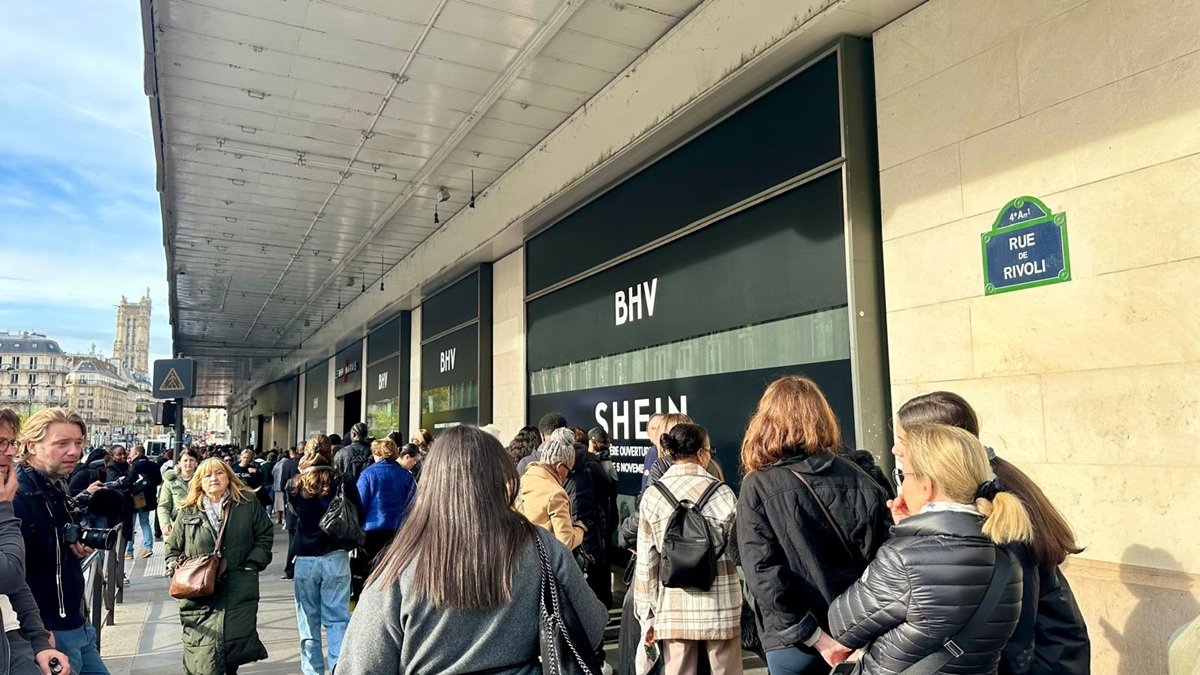

Shein delays its deployment in France. Shein’s arrival in the heart of the Parisian department store BHV, on rue de Rivoli, has triggered a very different scenario from the one SGM imagined when it decided to make the final leap into physical retail. The controversial opening on November 5th, which attracted tens of thousands of people on its first day of operations, has turned out to be a turning point with consequences that go far beyond the success of the store. The Parisian showcase has tested the operational capacity of the Chinese giant, while opening a national debate on the regulations of marketplaces and their presence in French commerce at the most sensitive time of the year.
With 1,200 square meters of floor space and located on the top floor of the iconic Le Marais building, the store caused a sensation and media impact coinciding with its opening. However, even among the faithful and curious, the landing met with critical glances. Shein disappointed a significant part of the public who expected to find the exact replica of the digital experience, with discounts and an extensive product offer. There was not much offer in men’s and children’s fashion or plus sizes, and neither did the rock-bottom prices that have made Shein a planetary e-commerce phenomenon appear, given that SGM has defended a positioning of searching for “the best clothes” from the Shein catalog. The lack of assortment and the distance with respect to its online offer now force to review the formula before replicating it in regional territory.
In parallel to the commercial noise, the reputational cost for BHV has been immediate. Shein’s presence in the building had already provoked the departure of dozens of French brands that refused to share space with the Chinese giant. In recent days, the exodus has continued with French ready-to-wear names such as the brands of the Smcp group or the firms Dior, Chanel, Guerlain and Lancôme, four pillars of the department store’s perfume business and guarantors of traffic in the run-up to the Christmas campaign. According to internal sources, more than twenty fashion, home and decoration brands had left the space or were about to do so, an exodus that amplifies the commercial tension and thins a critical category for the end of the year. The accusation of non-payments by the brands present in the BHV has been another of the main arguments behind this mass exit.
This context has forced SGM to slow down the expansion planned for Dijon, Reims, Grenoble, Limoges and Angers, where the opening was due to begin in mid-November. This process has also led the group to break its agreement with Galeries Lafayette, the licensee under which it operated the aforementioned regional centers. The group avoids providing specific dates and simply states that the delay will be a few days or a few weeks while the offer is adjusted and the rollout is redesigned.
Shein was planning to open physical stores in five other French cities after Paris
The setback is not only due to operational issues. The political and social climate surrounding Shein has a decisive influence on any move. The brand, which has become an international symbol of ultra-fast fashion, is the subject of growing institutional rejection. In Dijon, Mayor Nathalie Koenders has publicly expressed her opposition to the opening by stating that, although Shein had chosen Dijon, Dijon had not chosen her. The phrase sums up the public sensitivity surrounding the establishment of the Chinese giant in medium-sized cities and follows in the wake of contrary reactions from politicians such as the mayor of Paris, Anne Hidalgo.
The pressure is amplified by ongoing investigations and a rapidly tightening regulatory context. Since last November 5th, Shein has been under increased surveillance by the French authorities. The Dgccff (Direction générale de la concurrence, de la consommation et de la répression des fraudes) has launched a systematic control of the platform’s packages.The Dgccff (Direction générale de la concurrence, de la consommation et de la répression des fraudes) initiated a systematic control of the platform’s packages after the presence of pedopornographic dolls and weapons was detected on its marketplace. Although the inspection on November 7 confirmed that there were no longer any illicit products on the site, the group remains under close observation.
The platform will have to demonstrate the complete conformity of its catalog before the November 26 examination at the Paris Court of Cassation. On the same day, its representatives are summoned to appear before the Sustainable Development Commission of the National Assembly after having refused to participate in a previous mission on the control of imported goods. The summons includes a financial penalty in case of absence.
Shein’s physical progress is thus conditioned by a political climate that transcends any commercial issue. The group’s institutional agenda intersects with that of a government determined to examine in detail the functioning of international platforms in a context of unprecedented scrutiny.
Europe finalizes the introduction of taxes on small parcels under €150
The rethinking of SGM’s strategy also coincides with a key moment for Shein’s operating model in Europe. The finance ministers of the EU-27 have agreed to accelerate the introduction of taxes on small parcels of less than €150 sent from third countries. These imports, currently exempt from customs duties, underpin one of the fundamental pillars of Shein’s competitiveness on the continent.
The agreement could be formalized on December 12th, a milestone that would change the rules of the game for platforms based on direct-to-consumer shipments. The entry into force of stricter taxation would raise logistics costs and call into question the ultra-low pricing formula, just as the company explores its leap into the physical store.
Shein’s case is not isolated. The Dgccrf has also flagged other international platforms for similar practices. AliExpress and Joom were detected marketing pedopornographic dolls, while Wish, Temu, AliExpress and eBay offered A-grade weapons, including American fists and machetes. Wish, Temu and Amazon also breached obligations to filter pornographic images to protect minors. All six platforms have been notified to the public prosecutor, but Shein is the only one for which the state is requesting a complete suspension of activity.
For BHV, this context comes at the most critical time in the business calendar. Without its reinforced perfumery plant and with the public space dominated by the controversies surrounding Shein, the Christmas campaign becomes a test of endurance. The group’s management must balance the need to attract traffic with the preservation of a brand ecosystem that has historically underpinned its identity and margin.
The strategy of partnering with Shein was intended to open a new avenue for its regional department stores and add additional turnover in a sector that is increasingly dependent on tourist flows and the ability to differentiate offerings. The postponement forces to rethink deadlines and dimensions.
Related content

Shein Forecasts Profits to Soar to $2 Billion Despite Tariff Challenges
6 nov 2025 - 19:18

Chronicle of Shein’s Dramatic Arrival at Paris
6 nov 2025 - 05:00

Shein Appears Before European Commission Amid Potential Investigation
28 ene 2026 - 08:14

Shein’s Mystery Man: Discovering Xu Yangtian
15 ene 2026 - 05:00
Latest news
Birkenstock projects double-digit growth through 2028 with renewed strategy
29 ene 2026 - 11:16

Levi Strauss Boosts Profitability: Dodges Tariff Impact and Triples Earnings
29 ene 2026 - 11:15
H&M keeps its finger on the pulse and earns 4.6% more at fiscal year-end
29 ene 2026 - 11:10

Gordon Brothers Takes Over LK Bennett, Sets Stage for Global Expansion
28 ene 2026 - 12:33