Controversy, Crowds, and Government Action: Shein’s Tumultuous Paris Debut
Amidst boos, flashing cameras, and a line stretching around the iconic BHV department store in Le Marais, Shein boldly launched its first permanent store on the very day the French government ordered a halt to its digital platform.
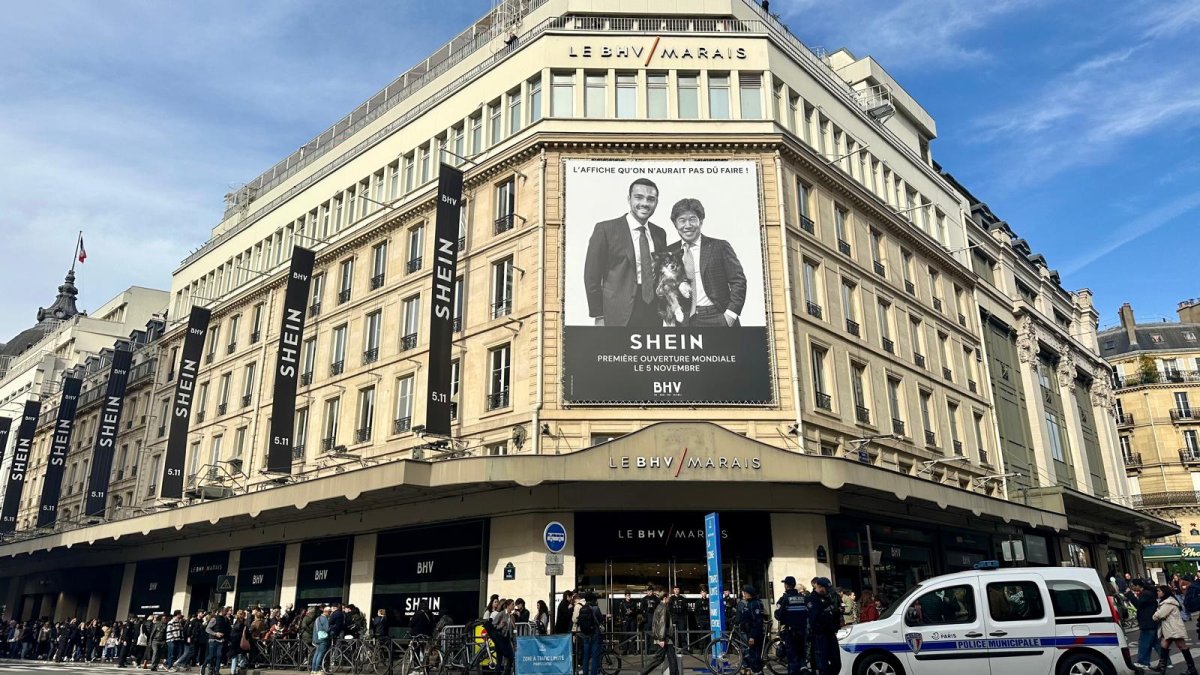

The last 48 hours of Shein’s landing in France could well inspire a Paul Thomas Anderson script. When it seemed that the controversy had reached its peak on the eve of the opening of its first physical store in Paris, the Chinese giant has surprised (much to its regret) with a new ace up its sleeve that has sparked a national controversy and forced the government of Emmanuel Macron to react. The Asian platform has been exposed to the limits of its own marketplace model defending the free market, in a cocktail of explosive ingredients that have combined the sale of illicit products, such as edged weapons or child-like sex dolls, unregulated production, unfair competition or the impact on the environment.
In a move seen as a frontal attack on the French ready-to-wear industry and the values of the République, the company led by Donald Tang has opened a political and social breach, and has come up against an “enemy” it had probably underestimated. A revolutionary cradle, France practices a statist, centralist and interventionist policy. And Shein has placed herself in the eye of the storm, the object of global debate multiplied by the national tradition of turning every issue into an ideological and cultural battle. Chronicle of the most awaited (and controversial) opening of the year in France: when Shein opened a store and the country was revolutionized.
In front of the Renaissance façade of the Hôtel de Ville, symbol of the republican and municipal power of Paris, tourists and clueless people mingled with dozens of demonstrators, onlookers and a long queue in the central rue de Rivoli around the block. The deployment of police and security surveillance was joined by an extensive procession of national and international journalists at the doors of the BHV Marais department store. On the sixth floor of the iconic building, details were being finalized for the inauguration scheduled for 1:00 p.m. on Wednesday, November 5. In the streets, controversy was rife and the contrast between Parisian heritage and the global fast fashion model was at its peak.
On the side of the City Hall, the opponents who had gathered to show their disapproval of Shein’s installation in Le Marais. “Shein, non merci”, summed up a huge banner of collective sentiment, although the protests were diverse and heterogeneous. Between environmental groups, activists and banners against forced labor or for the protection of minors, flags of the Xinjiang region in the square were heard booing and criticism of the conditions of the Uyghurs.
Shein has set up its first permanent physical store in the Parisian department store BHV
For her part, Mayor Anne Hidalgo had expressed her opposition to the installation, which she considers “contrary to the model of sustainable trade that Paris defends” and “a provocation” for the city.
In front of the demonstrators, Shein’s patient customers who had been waiting for several hours for the store to open. Some of them had arrived at six o’clock in the morning. Unperturbed by the criticism, the shoppers generally justified their presence “out of curiosity” or “because Shein is cheaper” and did not see a radical difference between the practices of the Chinese giant and other large fashion retail companies. The customer profile? Largely young and middle-aged women and groups of teenagers with cell phones in hand. In addition to being able to access Shein’s clothes immediately, the incentive was twofold: the department store had promised to reward shoppers with gift vouchers for the same value of the purchase that same day.
The anticipation for the opening was not dissimilar to that of past openings of flagship stores of giants such as Primark or H&M. However, the hectic atmosphere and the reinforced police presence underlined the controversial nature of the event and the tension of the day. Some passers-by recorded the scene with their cell phones; others asked what was going on. The image synthesized the conflict between two models: the city that claims its commercial history and the globalization that occupies it.
“Shein has chosen France as the laboratory for its final leap into physical retail,“ explained Donald Tang, the group’s executive chairman, in a statement. “It is only natural that this journey should begin in Paris, at the BHV, the cradle of modern commerce, before spreading to other cities.“ The much-criticized partnership with Société des Grands Magasins (SGM), owner of the BHV, includes the creation of 200 jobs and, according to the company, represents “a commitment to revitalize city centers and restore department stores.“ Tang presented the project as a gesture of “democratization of fashion” and “contribution to local commerce.“
The Chinese giant has been the subject of controversy for the marketing of illicit items on its marketplace
But the opening comes at a critical time. In addition to the judicial and social scandal, Shein accumulates fines worth €191 million in France for cookie infringements, misleading promotions and lack of transparency about its materials.
Inside, the department stores were virtually empty, with floors that, in recent weeks, have lost the presence of numerous French ready-to-wear brands in response to Shein’s entry. Occupying the sixth and last floor of the space, the Chinese giant displayed a complete range of women’s, men’s, children’s, accessories and sportswear. Around 6,000 references that, according to the space’s management, have been “carefully selected” among Shein’s millions of items. “It’s a beautiful space, a very pleasant atmosphere and I bought clothes that look like Sandro’s,“ celebrated one of the first customers to leave the department store with her Shein bag, amidst a background of boos and reproaches.
The price, one of the determining issues of Shein’s appeal, became one of the objects of criticism. “It’s not cheaper than H&M or Zara,“ reproached some customers. The offer, which incorporates some sub-brands of the platform (such as Dazy, Motf or Anewsta), ranges in price from 15 euros for the simplest pieces to around 100 euros for some leatherette coats. The composition, 100% polyester or polyamide. And the origin, made in China.
“We have paid attention to the product, its quality and its manufacture; we don’t sell Shein T-shirts for two euros here,“ defended Frédéric Mérlin, president of SGM, owner of BHV and most wanted man of the day, arguing that the positioning is slightly higher because retail does not enjoy the same offers and promotions as the platform. The leader, who could not hide his nervousness, argued to the press that “Shein has 25 million customers in France” and the products sold “meet European standards” and the opening “will attract new audiences to the center of Paris.“
The Shein store presents 6,000 references, priced from €15 to €100
The entrepreneur, who has become a public enemy of the French fashion industry, said that his goal is to “revitalize the activity of the department store and achieve good results. He added that “although I prefer not to claim victory, the first sensations are very good”. Faced with the controversy surrounding the illicit items on the marketplace, Mérlin agreed with the criticisms and said he was ready to take the necessary measures to resolve the situation.
Just a few hours after the inauguration, the French government announced the temporary suspension of the Shein platform, in reaction to the controversy over the sale of sex dolls and weapons. The measure, directly instructed by Prime Minister Sébastien Lecornu, obliges the group to demonstrate its compliance with French law and is part of the Executive’s strategy to strengthen control over foreign digital platforms.
Following the announcement, Shein announced the temporary suspension of the products of its external sellers in France, in order to review compliance with national regulations and “ensure the highest standards of consumer protection”. The company is thus facing a new regulatory offensive. Despite the pressure and the breakdown of the partnership between BHV and Galeries Lafayette, the group maintains its expansion plans in the country, with five new openings planned in Angers, Dijon, Grenoble, Limoges and Reims.
The French government ordered the suspension of the Chinese platform on the same day
In the face of the controversy, the French government described the opening as a “strategic error and danger, while the Minister of Industry, Sébastien Martin, denounced “a strategy of aggressiveness that attacks our values”. From the sector itself, Yann Rivoallan, president of the Fédération du Prêt-à-Porter Féminin, considered the operation to be “the great failure of the year.“ “Shein has already lost,“ he noted, arguing that “Shein’s strategy was to use the crowd effect to dampen controversy and pretend that it was representative of the French, but the reality is otherwise.“ The representative cited an Ipsos survey, according to which seven out of ten French call for measures to stop Shein. For its part, the Union Française des Industries de la Mode et de l’Habillement, the umbrella organization of the sector’s main federations, welcomed the decision: “We had asked for this suspension. We have been heard and we will remain extremely vigilant with regard to its application.
For the French business community, the presence of the Asian giant represents a direct threat to local trade and domestic production. The French case comes at a time when the European Union is debating new measures against ultra-fast fashion. In 2024, 4.6 billion packages under 150 euros were imported into the bloc, mostly from Asia, and the number doubles every two years.
.
Related content
Shein Faces French Ban, Puts Third-Party Transactions on Hold
5 nov 2025 - 09:43

Paris Investigation Targets Shein for Illegal Items Just Before Store Debut
4 nov 2025 - 06:57
Shein Appears Before European Commission Amid Potential Investigation
28 ene 2026 - 08:14
Latest news

Gordon Brothers Takes Over LK Bennett, Sets Stage for Global Expansion
28 ene 2026 - 12:33

Galeries Lafayette Finalizes Sale of BHV Building Amid Shein Controversy
28 ene 2026 - 12:30

VF Corp’s Q3 Results Shine with 28% Boost as Business Reorganization Unfolds
28 ene 2026 - 08:23

Claire’s Faces Another Setback in the UK with Second Bankruptcy in Six Months
28 ene 2026 - 08:21