Paris Investigation Targets Shein for Illegal Items Just Before Store Debut
French authorities launch an investigation into the Chinese fashion titan over the alleged sale of child-like sex dolls on its marketplace, just days before its contentious debut at Parisian department store BHV.



As Shein prepares for its grand retail launch in France, it grapples with a legal investigation over the discovery of child-like sex dolls on its platform, a scandal that has captured public attention and raised questions about e-commerce ethics. The Paris Prosecutor’s Office has opened a judicial investigation against the Chinese company after having detected the sale of child-like sex dolls on its platform. The scandal began a few days ago, driven by the virality of the controversy through social networks, and comes on the eve of the opening of its first permanent physical Shein store in France. The case, entrusted to the Office des mineurs (Ofmin), falls under the scope of the protection of minors and also affects other Asian platforms such as AliExpress, Temu and Wish.
As reported by Le Monde citing sources from the Public Prosecutor’s Office, the investigations focus on the “dissemination of pornographic messages or messages contrary to the dignity of minors”.and, in the case of Shein and AliExpress, the “dissemination of the image or representation of a minor of a pornographic nature”. The legal action comes after the Directorate General for Competition, Consumer Affairs and Fraud Suppression (Dgccrf) detected the presence of these items on Shein’s marketplace and reported them to the courts.
Through a statement issued Tuesday, Shein has assured that it will “collaborate 100% with justice” and that it will provide all the information requested by the authorities, including the data of buyers if required by the investigation. “We are in total transparency with justice,“ said Quentin Ruffat, Shein’s spokesman in France, in an interview with Bfmtv and RMC.
The group has withdrawn all products and visuals associated with sex dolls and announced the temporary removal of its “adult products” category. Shein has argued that this is an “internal dysfunctionality” and has confirmed the creation of a marketplace integrity taskforce, a tool to strengthen control procedures and supervision of sellers.
Shein has responded by removing the controversial items and inactivating its “adult” category.
The company has imposed sanctions on those responsible for sales, permanently banned “sex doll” type products and supported the creation of an information sharing mechanism between platforms and authorities to detect non-compliant operators. “The fight against child exploitation is non-negotiable for Shein,“ said Donald Tang, group CEO, in the same statement.
The case has provoked a strong reaction from the French government. The Minister of Economy, Roland Lescure, has warned that “if these behaviors are repeated,“ he will ask that Shein be banned from the French market. Lescure recalled that the State can veto platforms that are repeat offenders in the dissemination of illegal content, including pedopornographic content.
The High Commissioner for Children, Sarah El-Haïry, described the dolls as “pedo-criminal objects on which some predators train themselves before moving on to acts on children”. For his part, the Minister of Foreign Affairs, Jean-Noël Barrot, considered the discovery “unacceptable” and denounced the “invasion of the European market by non-compliant products”.
Shein will be summoned in the next two weeks by the parliamentary mission on the controls of imported products in France, which is seeking answers on the traceability of its supply chain and the corrective measures implemented.
Chinese giant to celebrate its grand opening under scrutiny
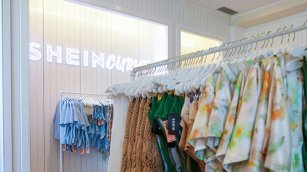
The investigation coincides with the opening of Shein’s first permanent retail outlet in France, scheduled for November 5 at the historic BHV Marais, owned by Société des Grands Magasins (SGM). On the building’s façade, a large banner shows Shein CEO Donald Tang alongside BHV owner Frédéric Merlin. The latter has described the sale of the dolls as “indecent and unacceptable”, although he has defended the agreement with the brand by claiming that “only garments designed and produced directly by Shein for the BHV will be marketed”.
The scandal adds to the three fines imposed this year on Shein in France for a total of 191 million euros, linked to infringements related to cookies, false promotions and lack of information on plastic microfibers. The controversy also follows the debate on the French law against ultra fast fashion, which aims to tighten the conditions for foreign platforms on the European market.
With the ready-to-wear sector against it, what was supposed to be a provocative blow on the Parisian scene by Shein has turned into a judicial and reputational crisis that tests its credibility with the French and European authorities, at a time of increasing vigilance on global e-commerce.
The case recalls other recent episodes in which the fashion industry has been accused of trivializing child representation. In 2022, Balenciaga withdrew an advertising campaign after criticism for showing minors next to objects with sexual connotations. That episode, which led to a public apology and an internal review of its creative processes, set a precedent for the ethical limits of visual communication in contemporary fashion.
Related content
Shein Sees 13% Profit Dip in 2024 Despite Sales Surging to $37 Billion
15 oct 2025 - 17:59

Shein Faces Sales Slump with 8% Drop Following Minimis Policy End in the US
10 oct 2025 - 11:00


Shein Appears Before European Commission Amid Potential Investigation
28 ene 2026 - 08:14
Latest news
Gordon Brothers Takes Over LK Bennett, Sets Stage for Global Expansion
28 ene 2026 - 12:33

Galeries Lafayette Finalizes Sale of BHV Building Amid Shein Controversy
28 ene 2026 - 12:30

VF Corp’s Q3 Results Shine with 28% Boost as Business Reorganization Unfolds
28 ene 2026 - 08:23
Claire’s Faces Another Setback in the UK with Second Bankruptcy in Six Months
28 ene 2026 - 08:21