Quiet Luxury with Spanish Flair: Polène’s Revolutionary Impact on Ubrique
From the workshops of Cádiz to the Champs-Élysées, Polène has transformed craftsmanship into the language of French luxury. The leather goods brand by the Mothay family, backed by L Catterton, now boasts a turnover exceeding €140 million.
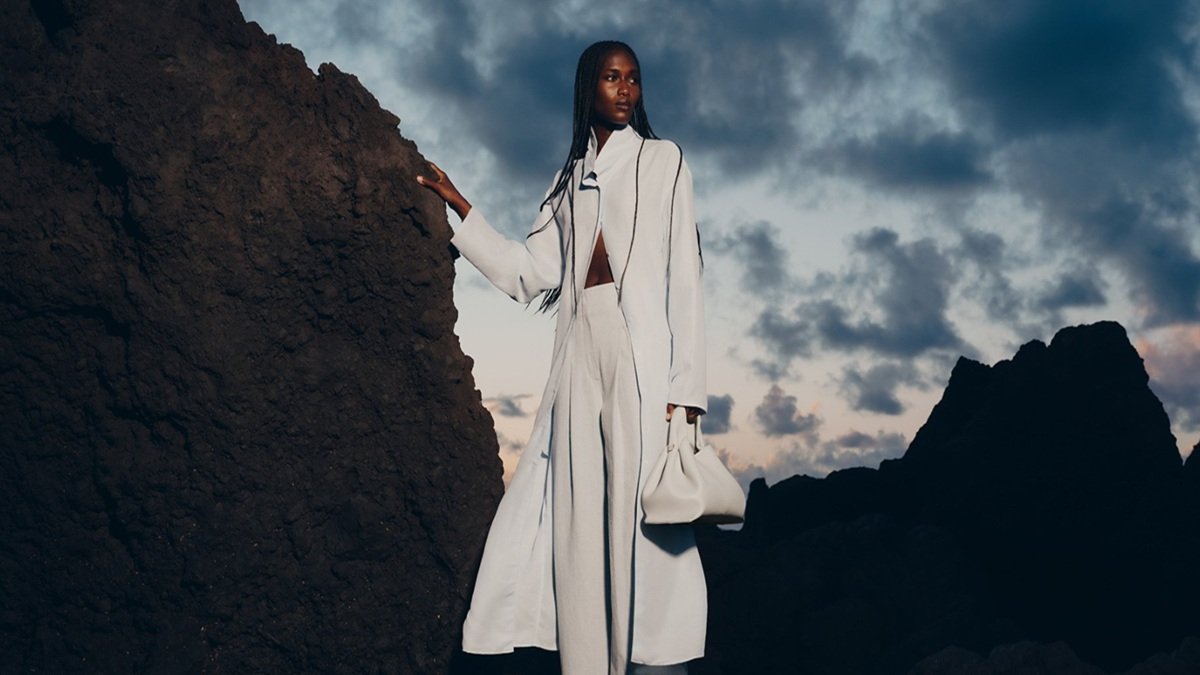


In the most emblematic avenue of Paris, handmade bags created in Ubrique, the Cadiz town that has become the workshop of the new French luxury, are causing a sensation. In the bustle of the Champs Elysees, the brand Polène has built a space without artifice, where the design is pronounced in a low voice and the material speaks for itself. The brand’s store, located at 2, Rond-Point Marcel-Dassault, displays 450 square meters of sculptural calm and the collections of a project that has become the object of desire of customers eager for luxury as accessible as it is minimalist. Among tall columns, enveloping curves and hand-carved furniture, Polène defends an atmosphere based on control and precision as a global language, while from the workshops of Ubrique they say with the discretion that characterizes them that this firm, the latest phenomenon of luxury, is taking over more and more production lines.
Commissioned to the South Korean studio Wgnb, the Polène store opened partially in December 2024 and culminated its full opening in April 2025, with the presentation of the upper floor and the Atelier de Curiosités, a sensory space where visitors can see, smell and hear the gestures of the leather craftsmanship. There, each material tells a story that takes visitors back to the workshops of Ubrique, among oak tables covered in compressed leather and lined counters.
Upstairs, a table-installation created by Clémentine Debaere-Lewandowski brings together 500 pieces of white stoneware molded from rocks quarried in the area around the town of Cádiz, where all the brand’s leather goods are produced. What may seem a mere anecdotal gesture is rather a close link between the Spanish industrial heartland and the Parisian setting. Paris signs a dream story, while Ubrique manufactures it.
This two-speed logic also ensures the protection and viability of a traditional craft that artisans like Sonia, José María and Ángel have been learning since they were teenagers, inheriting family practices. Following in the footsteps of French savoir-faire, mastered and defended with mastery by historic Moroccan luxury leather goods maisons such as Louis Vuitton, the company has been able to develop a new line of products and services.a luxury goods such as Louis Vuitton or Hermès, Polène not only communicates its artisanal values and its European production, but also claims it out loud. Ubrique thus functions, in the French luxury industry, as a seal of tradition, quality and traceability that catapults the brand’s bags to the stage of the bestsellers of the moment.
Polène, the leather goods firm of the Mothay brothers, has opted for a ‘quiet luxury’ positioning
Founded in 2016 by siblings Antoine, Elsa and Mathieu Mothay, Polène was born with the ambition to build a luxury brand without media noise, ostentatious campaigns or intermediaries. In the midst of the saturation of the market of accessible luxury and products on the social networks of the influencers of the moment, the Mothays opted for a direct-to-consumer sales model, with a recognizable aesthetic identity and a coherent discourse that did not need ambassadors or advertisements and that would also seduce a sophisticated and timeless clientele that is very connected to Asian values.

Since then, growth has been organic, sustained and, above all, measured. First the online channel, then a network of flagships selected in strategic locations. Paris, first with a space on rue de Richelieu and then a point of sale in Le Bon Marché, marked the beginning of an expansion that has taken Polène thousands of kilometers from its origins in Ubrique. From New York’s SoHo to Minamiaoyama in Tokyo, Garosu-gil in Seoul and Regent Street in London. His most recent installation, on the Champs-Élysées, marked his landing at the kilometer zero of world luxury.
The business development strategy is based on two pillars. First, control of margins, image and selective distribution. And secondly, aesthetic consistency on all surfaces of the product and space. Polène does not outsource its storytelling, but designs it, accompanies it closely from its made in Spain production and takes care of every detail until it leaves the point of sale.
So far, this requirement has allowed it to maintain high margins and scalability without sacrificing product consistency. In 2023, the company reached €142 million in sales, according to Le Monde, with 80% international turnover. A year later, in September 2024, the L Catterton fund, an investment vehicle of the French luxury group LVMH, took a minority stake, following the exit of the Eutopia and Otium funds. The transaction, the amount of which was not disclosed, allowed the brand to strengthen its financial muscle and distribution network without losing family control.
LVMH became a shareholder of the brand in 2024 through L Catterton
The prices, ranging from 260 euros to 620 euros depending on model and material, place Polène in the contemporary luxury category below the traditional maisons, but well above the mass premium. Its icons, christened in series as Numéro Un, Numéro Neuf or Numéro Dix, presume to be recognizable despite their minimalism. Each piece is characterized by soft folds, enveloping curves and a restrained color palette that avoids excess and appeals to the material sobriety of origin.
In its launches, Polène appeals to relatively accessible exclusivity. The queues in front of its stores are frequent, even more so since the entry of L Catterton in the capital that was a boost in sales driven by the interest of the luxury giant.

Thus, seasonal drops are limited, capsules are sporadic and loyalty is built on the perceived quality and permanence of the design. Rumors of a progressive price increase are also a sales driver among the firm’s followers, who rush to collect the firm’s designs before it is too late.
Ubrique as a laboratory of the new European luxury
As in the case of other luxury brands, Polène’s production nucleus is in Ubrique (Cádiz), a historical enclave of European leather goods. Some 5,000 to 6,000 people work there in some 290 companies, which account for 75% of Andalusia’s leather goods production. The craftsmanship of the Cadiz mountains has been supplying maisons such as Loewe, Dior or Carolina Herrera for decades, but Polène has been the French brand that has most recently claimed this link publicly, underlining its collaboration with 1,300 local craftsmen.
The company assures that all its pieces are handcrafted within a radius of five kilometers, with audited workshops and a short traceability circuit. This organization allows total control of the process, from prototype to shipment. The result is a highly specialized and flexible industrial network, capable of responding to short series and rapid replenishment without compromising quality.

Ubrique’s know-how, which ranges from cutting to finishing, sewing and assembly, translates into products where manual precision coexists with industrial efficiency. In a sector that is moving towards transparency and responsible production, this model of proximity has become its main competitive advantage. All the leather used by Polène is of European origin, coming from Spain and Italy.
Polène’s boom coincides with a time of industrial curves for Spanish fashion. In 2024, the leather and footwear industry reduced its turnover by 6.1% compared to 2023, according to INE data, and production fell 8.3% year-on-year. Despite this, the price of the segment’s exports grew by 1.3% and their total value increased by 5% to €5,408 million between January and November, according to Icex.
Ubrique, which has become the Spanish capital of leather goods, has held up better than other industrial centers thanks to its integration with international luxury. For workshops in Cádiz, working with brands such as Polène has meant armoring themselves against the volatility of volume fashion. The model also reflects a cultural mutation. Luxury no longer needs to manufacture in Paris to be French, but can conceive in the capital and manufacture in the periphery, as long as the excellence and the story are consistent. In that sense, Ubrique has become an extension of the emotional geography of European luxury.
The coming months will be decisive for Polène’s next stage of growth. With new openings planned in Munich, Dubai and Miami, the brand will test its ability to expand without diluting its essence. The challenge is to keep production concentrated in Ubrique and to maintain quality in every workshop and product that reaches the stores.
Related content
LVMH Eases Decline, Sales Reach €58.09 Billion Through September
14 oct 2025 - 16:24

LVMH Expands Global Footprint, Eyes South Korea Amid Downturn in China and US
26 sep 2025 - 07:14

Latest news
Swatch Sees 89% Profit Decline in 2025 Amid Tariff Woes and Sluggish Demand
30 ene 2026 - 04:26
Inditex’s Eduard Casabella on Oysho’s Sport Pivot and Growth Through Identity
29 ene 2026 - 18:40
McKinsey’s Gemma D’Auria on Luxury’s Pullback and Fashion’s Resilience in 2026
29 ene 2026 - 18:35