Fresh Concepts and Resilience: Who’s Next Sets the Pace for Paris Fashion Fairs
Amidst a backdrop of uncertainty, the French fashion, footwear, and accessories fair, held from September 6 to 8, became the industry’s epicenter, featuring around 650 brands, including over 50 from Spain.
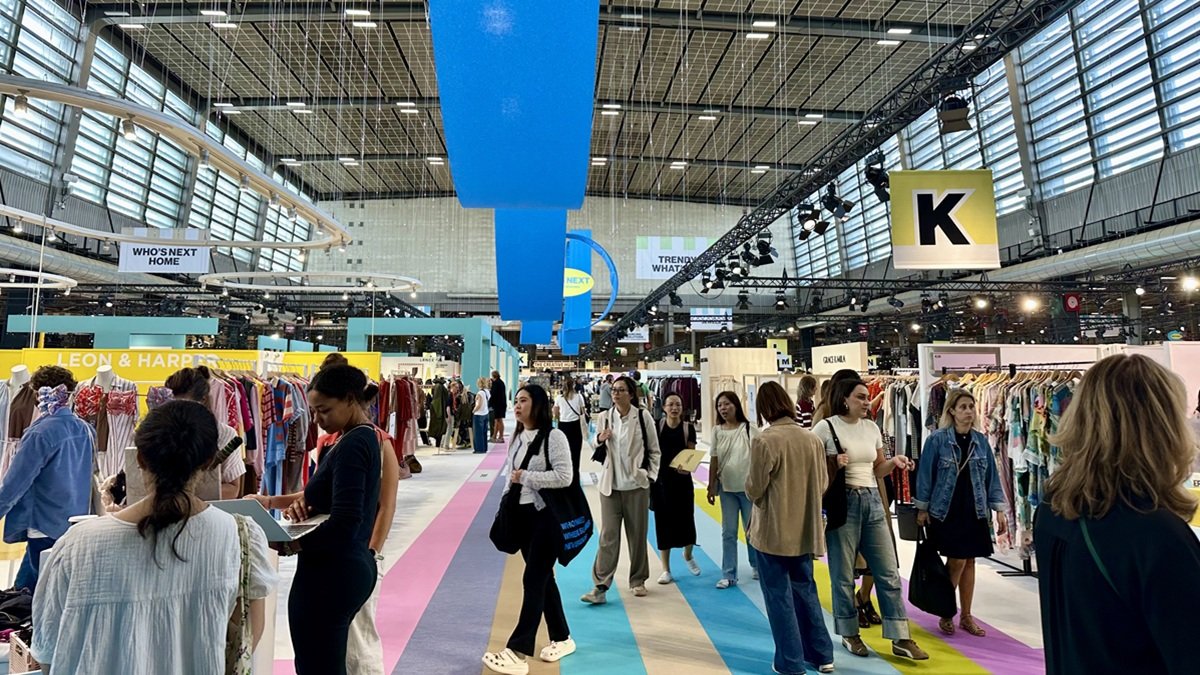

Who’s Next kicks off the fashion season in the French capital, returning to the Porte de Versailles exhibition center from September 6 to 8. The trade show, a regular appointment on the first weekend after the August break, is facing a complex environment. Beyond the international macroeconomic context, marked by inflation, the slowdown in consumption and tariff uncertainty, France is navigating in a stormy climate.
The government crisis, only eight months after the appointment of Prime Minister François Bayrou, is paralyzing ongoing reforms, increasing consumer distrust and threatening decision-making in the face of an unknown future. In addition to the bad political moment that Emmanuel Macron is going through, there is a general strike scheduled for September 10. And fashion, a sensitive thermometer of the economic situation, is once again appealing to resilience, while the French sector continues to suffer from the gradual decline of traditional ready-to-wear.
Despite the circumstances, the mood at the show was generally positive. There were generalized echoes among the local brands that the context and the challenges are a bit “more of the same” and there are almost no surprises around the difficulties of staying in the sector. The economic crisis, companies in competition, changing tariffs, the impact of the pandemic or the threat of Chinese low-cost competitors, which France intends to limit with the expected implementation of the so-called Shein law, are some of the obstacles encountered throughout the history of many exhibiting companies. Is the context even worse today? Out of frustration or out of habit, it seems that the fashion industry does not even see the interest in asking itself this question. The good times are long gone and the participating brands are ready to grit their teeth to move forward.
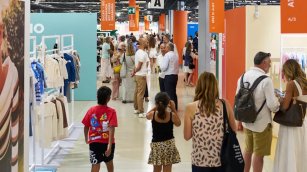
With a neat and bright staging, as well as a marked creative direction, the fair occupied Hall 1 of the venue under an infinite summer theme. The latest edition of the event merged its offer with that of the format dedicated to fashion jewelry, Bijhorca, and that of the concept linked to sourcing and professional solutions, Interfilière, with a large presence of resort and beachwear brands. By displaying all its proposals on the same surface, intermingling leather goods, footwear and beauty brands (with some twenty participating brands such as the British Amory London, Moroccan Yazine Cosmetics or the French brands Holilab and Cocoon Paris) with ready-to-wear, Who’s Next aims to meet the needs of a multi-brand market increasingly oriented towards complete looks in stores.
Who’s Next is diversifying its offer with spaces dedicated to beauty, sourcing and decoration.
“By bringing together Who’s Next, Bijhorca and Interfilière in the same space, the WSN group proposes an event of unusual coherence, an event designed as a platform for activating change that structures the entire textile and fashion value chain: from the sourcing of raw materials to the final distribution circuits,“ say the fair, noting that the movement aims to create an “ecosystem that allows for efficiency gains”.
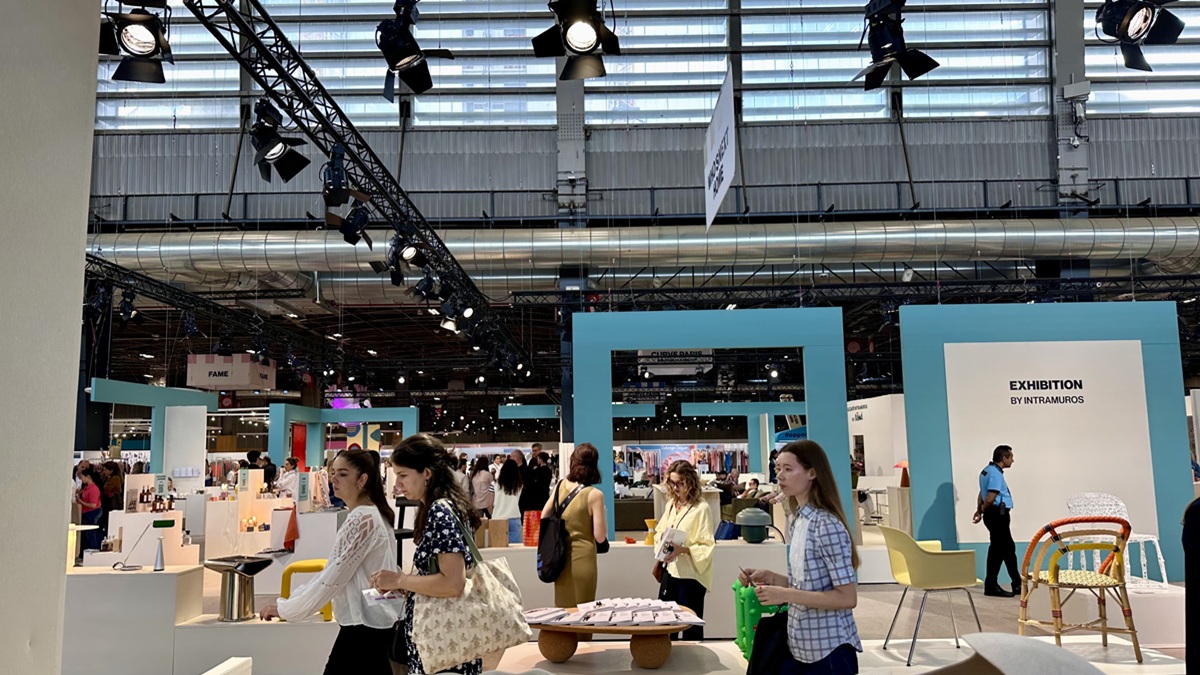
In addition, the fair responds to another growing trend in retail: the rise of designer concept stores, establishments that diversify their offerings with carefully curated catalogs of products that go beyond fashion, with the aim of seducing new customers and turning stores into living spaces. Thus, the show proposed a Home area, dedicated to design and decoration, with the participation of almost forty brands such as the historic Opinel and Duralex, the stationery specialist Papier Tigre or the Spanish ceramics of Jorceramics.
“For thirty years, Who’s Next has been inspiring and connecting the fashion ecosystem through a bold selection of brands, ideas and experiences - the event organizers explain -; the show has become more than just a professional appointment: it reveals trends, catalyzes mutations and accelerates connections.“ With Who’s Next Home, the show “naturally opens a stage in an unprecedented sector to respond to the reality of retail in transformation” and presents a selection adapted to the “evolving multi-brand” towards “hybrid spaces, concept stores, lifestyle spaces, pop ups with a strong identity...“.
To accompany the creative and professional purpose of the event, Who’s Next also presented a trend study prepared together with the French specialist Tagwalk. With a focus on chromatic trends (including an 11% increase in green shades) or the designs of catwalk firms that set the trends that land in stores, such as a 180% increase in pleats or a 115% increase in the use of polka dots, the report for the spring-summer 2026 season forecasts a rise in fluid designs, long dresses and bohemian touches.
Lola Casademunt, Flabelus, Yerse or Bobo Choses: more than 50 Spanish brands at the fair.
Through a route segmented by formats and set out with Ikea-style colors, the fair reinforced its purpose of raising the tone, even in the most accessible proposals. Around the dynamic aisles, especially during the second day of the show as multiple brands celebrated, large, aesthetic stands were organized with limited product exposure, responding to a showroom style.
With a majority of French exhibitors, such as Leon&Harper, Terre Rouge or Rue Mazarine, the fair had a broad international representation with the participation of brands from countriessuch asItaly , Germany, the United Kingdom,France, Germany, Italy, the United Kingdomand the United States.The fair was represented by brands from countries such as Italy, Germany, the United Kingdom, Greece, Switzerland, Belgium, the Netherlands, Sweden, Morocco, Turkey, Armenia, Brazil, Colombia, Georgia, China, Japan, Nigeria, Ethiopia and Indonesia, among others. After the decline of the trade fair fabric in Germany, Paris defended, for another season, its role as a central place and meeting point for fashion business on the international map.
Thus, many of the participating Spanish companies already have a solid track record, such as Yerse, Bobo Choses, Flabelus or Nice Things, and approached the event under the premise of business continuity and expansion. Or what amounts to the same thing: to be where they need to be in order to maintain and expand their respective models. “There have been many people and we have registered quite a few orders”, celebrated from Lola Casademunt, pointing to an “acceleration of expansion” with customers from markets such as Canada, Japan, Ecuador, Jordan, Lebanon, Ukraine or even Kuwaiti.
In addition, the Catalan brand described a return of orders from Polynesian buyers, who usually come to place a large annual order for the summer season. Continuing with the French-speaking markets, the company noted a lower influx of Belgian buyers and a certain wariness on the part of the French. “Potential customers in France think long and hard before taking the plunge, it’s hard to convince them,“ they acknowledged.
Spanish companies are attending the Paris trade fair to boost their international expansion.
Also with its sights set on the Gallic market, The Tiny Big Sister participated for the third consecutive time and described its presence as “very positive and satisfactory.“ “Who’s Next is the most international and important fair in Europe and we aspire to establish ourselves more in France,“ they explained, citing good contacts with Asian and Latin buyers during the show.
For its part, the women’s fashion brand Lolina described with optimism the reception of its colorful garments and original prints. “Given the current times, it is noticeable that buyers are looking for positive and different garments,“ said its founder, Carolina Orts, mentioning the visit of French, Swiss, Dutch and Japanese buyers. With Spain as its first market, where its commercial presence extends to 250 points of sale, the brand attended the fair for the second time to advance in its expansion. “We already have sixty multi-brand points of sale in Greece and we want to continue growing,“ said the entrepreneur.
There was also room for national premieres. The resortwear brand Naïve, which already has four stores in Madrid, landed in Paris with the aim of continuing to position itself in potential markets, while the emerging Barcelona upcycling firm Alsedà had its first trade fair experience with a focus on “market research and visibility”.
With a hundred stores in the domestic market, a dozen in Portugal and two in Egypt, the women’s brand Camaleónica by Capriche enjoyed a “positive first experience” that resulted in the opening of new markets such as France, Mexico and Belgium.
The footwear segment, however, was probably the one that faced the most difficult challenge. In addition to the coincidence in dates with Micam, the Milanese reference par excellence of the footwear industry, there was the fact of being converted into a plus of the fashion offer. Most of the buyers attending Who’s Next supply clothing stores and not footwear stores, so the work has more to do with representation and visibility. Orders, in many cases, are residual.
“For footwear companies it has not been a profitable participation, as the bulk of the sector is in Milan, but we see it as a long-term image investment,“ reflected the Gallic representative of the Elche-based footwear brand Cetti. With Spain, Germany and Switzerland as its main markets, the family-owned company aspires to “position itself in France with a strategic geographical deployment”. Currently, the brand already has 140 customers in the country, including Jef and Spartoo. With sixty employees, the discreet company produces 50,000 pairs per year.
The trade fair calendar continues this week in Madrid, with the celebration of the KM0 Moda event on September 8 and 9 at the Palacio de Santoña, as well as Momad, which will take place at Ifema from September 11 to 13.
Related content
Trade fair marathon in September from Shanghai to Madrid and Paris
3 sep 2025 - 05:00
Pitti Bimbo Stands Firm Amid Kidswear Storm
24 jul 2025 - 05:00

Swatch Sees 89% Profit Decline in 2025 Amid Tariff Woes and Sluggish Demand
30 ene 2026 - 04:26

Latest news
Swatch Sees 89% Profit Decline in 2025 Amid Tariff Woes and Sluggish Demand
30 ene 2026 - 04:26

Inditex’s Eduard Casabella on Oysho’s Sport Pivot and Growth Through Identity
29 ene 2026 - 18:40

McKinsey’s Gemma D’Auria on Luxury’s Pullback and Fashion’s Resilience in 2026
29 ene 2026 - 18:35