

Richemont’s Jewel-Studded Defense: Challenging the Giants as Luxury’s Resilience Leader?
As the luxury sector reshuffles, Richemont leans on its most resilient asset: jewelry. With double-digit growth, the Swiss conglomerate enters the conversation on which player can withstand the industry’s slowdown best.


Creative overhauls, adjustment plans or even the signing of top executives. For months, the luxury industry has been looking for a formula to get out of a crisis that has hit the bottom line for the last few months, knocking brands that had been the locomotives of turnover and leaving the hóldings in uncomfortable doubt as to whether it is possible to return to the same growth rate of yesteryear or, at least, to the same level of growth as in the past.This has left the polders facing the uncomfortable doubt as to whether it is possible to return to the same rate of growth as in the past, or at least to regain a dynamism that would be reassuring to shareholders. While some groups have reordered their story around design changes, especially in the fashion divisions, Richemont has settled on a seemingly simple but effective strategy: focus on the product that is bought when the customer consumes less, but chooses better.
In this turbulent context, Richemont has re-entered the top of the performance cycle with a quiet advantage. Not only does the Swiss conglomerate publish earlier than most of its peers, it also does so from a category that is better withstanding the heavy digestion of luxury. In a sector where 2026 starts with more question marks than euphoria, the Swiss holding company has put figures on the October-December quarter, the stretch that usually sets the debate at the start of the year.
In the period, Richemont achieved sales of 6,399 million euros. At constant exchange rates, the increase was 11%; while at current exchange rates, the advance was 4%, with the currency effect again conditioning the reading of the business, especially in Asia.
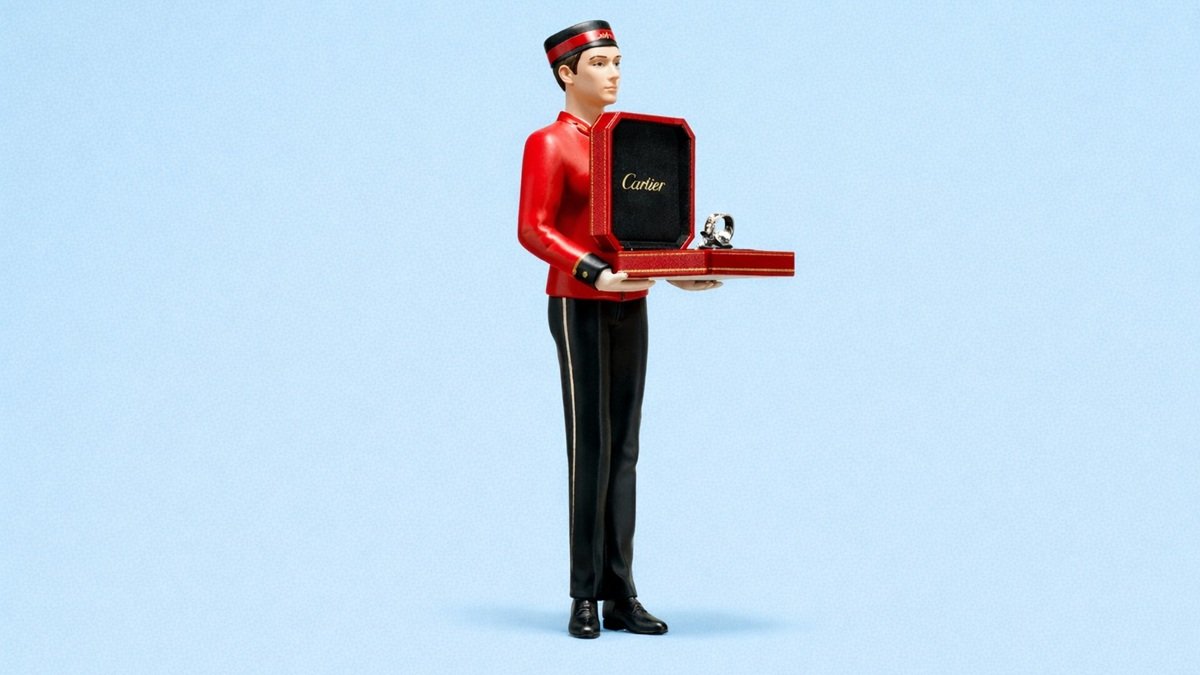
The driving force behind the turnover was none other than jewelry, the company’s star category, which increased its sales by 14% at constant exchange rates, to 4,785 million euros, thanks to the performance of firms such as Buccellati, Cartier and Van Cleef & Arpels. For its part, the specialized watchmaking segment, in which it operates with names such as Piaget and Panerai, also accompanied, with 872 million and an increase of 7% at constant exchange rates. The rest of Richemont’s other divisions remained stable at constant exchange rates and, within fashion and accessories, grew by a slight 3%, highlighting the momentum of Peter Millar and Gianvito Rossi.
Richemont reinforces its jewelry thesis in a luxury that is losing momentum
These results are best understood by contemplating the full picture that defines why jewelry holds the pulse better than fashion and resists the cycle. The global jewelry market exceeded €130 billion in 2024, up from €97 billion in 2015, according to Mediobanca. The map is also shifting. China reduces weight and new hubs emerge, while Italy gains ground to 11.2% of world trade, ahead of Switzerland.
In addition, the jewelry consumer is and buys very differently from the fashion consumer. The sector is less dependent on turnover, is more protected by the high ticket, heritage, loyalty and a patrimonial component that, in periods of prudence, acts as a cushion. This advantage, however, also has a flip side. The more dominant the jewelry engine is, the more dependence increases and leaves fashion, where it competes with historic brands such as Chloé or Alaïa, in a discreet second place.
In line with the strength of the division, the retail channel reached 72% of sales in the quarter to 4,601 million euros and the group placed the direct-to-customer business at 78% of sales, stable compared to the same quarter of the previous year. More direct sales means more sophistication and control of price and experience, in line with the demands of the luxury customer. But it also means more operational and investment requirements.
If luxury cools down, fashion is the first to send signals. While desire need not disappear, consumers are buying less, choosing more and discussing price with a different intensity. That’s why Richemont is closing the nine months with peace of mind, because its backbone is not fashion. And that, today, is an advantage.
Fashion remains the most sensitive front of the cycle.
Within the fashion and accessories segment, the group brings together Alaïa, Chloé, Delvaux, Dunhill, Gianvito Rossi, Montblanc, Peter Millar, Purdey and Serapian. For the group, the category does not function as a traction business, but as a territory of image, positioning and potential margin.
Alaïa is the clearest example. In terms of creative narrative and prestige, the French-Tunisian designer’s maison functions as a beacon brand within a portfolio defined by jewelry and watchmaking. The house experienced a turning point after the death of Azzedine Alaïa in 2017 and, in 2021, Pieter Mulier took over as creative director with a career linked to Raf Simons and stints at Dior and Calvin Klein.
That context matters because, precisely because it is smaller, fashion at Richemont is more sensitive to talent movements. Now that the company has consolidated its new image, acquired the respect and validation of the sector and signed important retail operations, several sources place Mulier among the names that could sound to take over the creative direction of Versace after the departure of Dario Vitale, Donatella’s replacement. If this scenario is confirmed, the impact for Richemont would be less financial than symbolic because it would lose the figure that concentrates much of the cultural capital of its fashion portfolio.
A comparison with the momentum of other companies in France puts things in perspective. Kering closed Q3 2025 with sales of 3,415 million euros and a 5% drop in comparable. In nine months, these stood at 11 billion and were down 12%. The recipe for turning the situation around? The formula Luca De Meo, its new CEO, who is ready to take the necessary measures to turn the corner.
LVMH leads the podium, with Richemont in second place.
Bernard Arnault’s group, for its part, closed a period of inflection. The French holding company posted a turnover of 18.28 billion euros (sales triple those of Richemont) between July and September, up 1% in organic terms. The increase came after a weaker start to the year. In nine months, sales stood at 58.09 billion, down 2%. The quarter was therefore recognized as positive, thanks to selective retail traction with the leverage of Sephora. The nuance, as in almost all European luxury, was currency, with an impact that weighed 5% in the quarter.
LVMH and Kering will shortly publish their year-end financial statements, which in both cases are on a calendar year basis. Richemont, on the other hand, operates on a fiscal calendar with the year-end scheduled for March 31, 2026, with results to be presented on May 22.
The ranking by size gives the Swiss group the silver medal. By turnover in 2024, LVMH leads with 84,683 million euros, Richemont reached 20,616 million in its fiscal year 2024, while Kering closed the year with 17,194 million. They are different models, however. LVMH is an ecosystem of categories; Richemont is a jewelry machine with satellites; and Kering, finally, is a more concentrated bet on fashion that needs to recompose itself in a more demanding market moment. Its latest initiative? Getting rid of the beauty business to concentrate, once again, on fashion.
In this competition, Richemont has a structural advantage, but not an automatic one. In the nine-month period from April to December 2025, it increased sales by 10% at constant exchange rates, to 17.018 billion euros, and closed December 31, 2025 with net cash of 7.6 billion euros. These are figures that speak of solidity, but over which also hovers the question of how much growth it can continue to extract from its jewelry backbone in a market that points to a 2026 of moderate growth.
Those forecasts put the luxury personal goods market down around 2% in 2025 to €358 billion, with a possible return to growth of between 3% and 5% in 2026. Not a doomsday scenario, but one of selection. And when luxury becomes selection again, the question mark that floats behind the numbers appears. Is Richemont the most resilient luxury holding?
Today, jewelry is pushing, America and Japan are responding, Asia is improving without euphoria, retail is holding up and the direct business retains a high weight. The jewelry advantage is evident; the challenge is to build a second engine without diluting what makes the group different. In this debate, movements such as Alaïa’s future weigh more than its figures suggest.
Related content
Richemont Sparkles with 11% Sales Rise, Driven by Jewelry Demand
15 ene 2026 - 07:38

LVMH: Color Over Champagne in a Year of Resilience
24 dic 2025 - 05:00

Kering’s Ground Zero: Steering the Brand into a New Chapter
24 dic 2025 - 05:00

Latest news

Asics Strengthens Production: Onitsuka Tiger Launches First Factory in Japan
16 ene 2026 - 08:03

Etam Group Restructures Leadership: Undiz CEO Elevated to Head Main Brand
16 ene 2026 - 07:54
Ralph Lauren Ventures into Entertainment: Taps Universal Talent for Board
16 ene 2026 - 07:52


