Kate Fletcher on the Roots of Ultra-Fast Fashion and Shein’s Unstoppable Rise
As the fashion world grapples with new sustainability hurdles, the British author and researcher who first popularized a pivotal sector term nearly twenty years ago weighs in on the industry’s path forward.
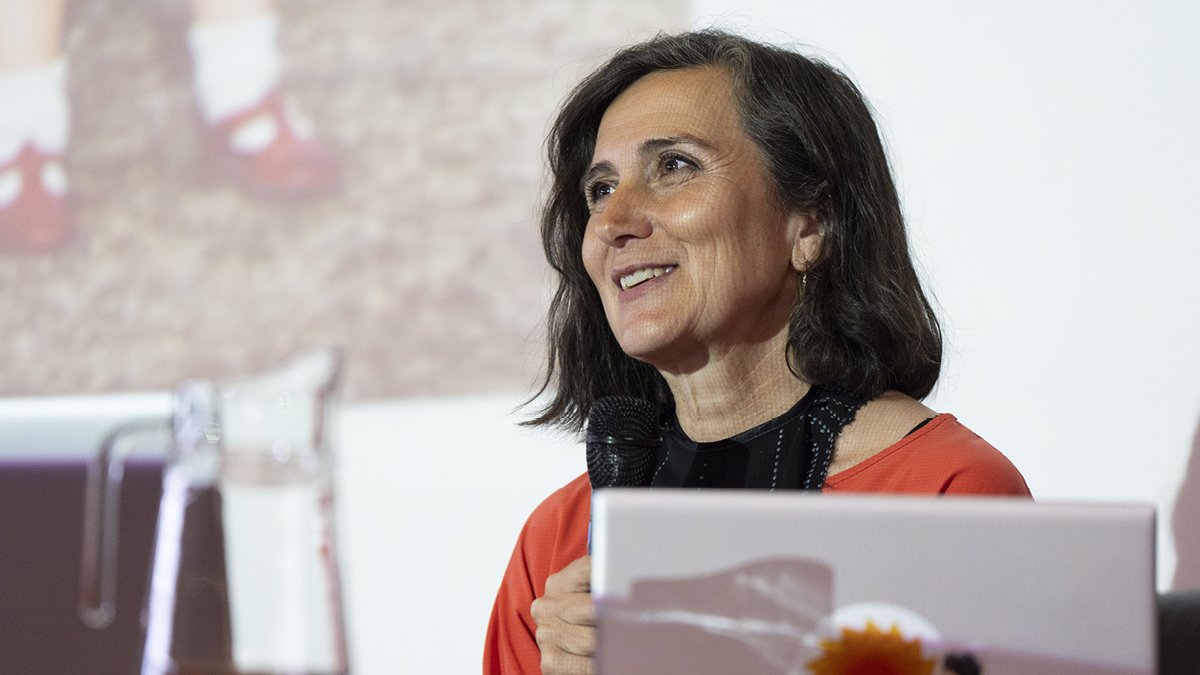

Kate Fletcher started talking about sustainability in fashion when no one else was doing it. The British researcher, professor and writer first coined a term, slow fashion, in 2008, giving a name to something whose magnitude was unknown. Although today the challenges facing the sector have changed, fashion continues to make progress in its struggle to survive a change of model that seems inevitable. Almost two decades later, the expert analyzes the changes that the industry has yet to implement, an unexpected (and even beneficial) effect of the tariffs imposed by U.S. President Donald Trump, or the instability of the Shein phenomenon.
Question: You are known as the creator of the term slow fashion. What does this concept mean and how has it changed in the last decade?
Answer: This idea ultimately tries to make us question the role of fashion in our lives. It was very much influenced by the slow food movement, which started in the 1980s in Rome, after a McDonald’s opened on the steps of the Spanish Steps. And Rome, or Italy in general, being a society that places so much importance on cuisine, was horrified by the idea that food would be delivered in such a homogeneous way, at an identical price and size and of low quality, killing Italy’s culinary diversity. Slow food was born to try to combine taste and ethics with a political vision, and in many ways, slow fashion was trying to do the same, to unite this idea of beauty and ethics to express ourselves and be creative in fashion, but while thinking about the consequences. Over time, the concept has evolved, especially after the birth of fast fashion, whereby the cycle of consumption and buying clothes has accelerated. But the point here is that what you can’t speed up is the cycle of, for example, a cotton bale. The plant needs the same time to grow whether it ends up in a T-shirt from a fast fashion or slow fashion company.
Q.: Are they two completely opposite concepts?
A.: I personally believe that slow fashion is simply an opportunity for us to think much more deeply about how to change the debate. It is not only the opposite of fast fashion, it has to serve us also to ask ourselves more deeply about how we want to dress, what it means to produce and consume in the era of environmental emergencies. What if it has changed over time? I hope it hasn’t in terms of growth, because scalability is ultimately not the most important thing.
Q.: I don’t know if you can elaborate a little bit more on that, because at the end of the day what we’re continually talking about in the industry right now is the ability to scale sustainable solutions?
A.: The big challenge in fashion in terms of sustainability is the volume of clothing, which is not only very high, but growing. And fundamentally, the only way to fight overproduction is simply to produce less. And for now, we are trying to avoid getting to this, and we are focusing on innovating, for example, looking for different substitutes for certain fibers or applying durability criteria, but what I mean when I say that we should not get carried away with scalability and try to go to deeper questions, is that if, finally, we insert slow fashion into a system that is running out fast, we are not solving anything.
“The only way to fight overproduction is simply to produce less.“
Q.: Is Shein the McDonald’s on the steps of Rome’s Spanish Steps for fashion?
A.: The birth and rise of Shein was almost inevitable. Fast fashion is not about speed, it’s a business model based on selling high volumes at low prices, and aside from that, it uses some technologies that help speed up certain processes in the system. And, in many ways, Shein is a logical conclusion of that business model. And, aside from that, when you have that speed and ability to put so many items on your website, it almost collapses the idea of trends, there’s no consistency anymore. One of the things that Shein is generating, beyond the impact on the environment, is the instability that it cultivates in us as people. We are living in societies where we have become accustomed to pleasure and dopamine hits sometimes, and feel the rest of the time that we are not enough, and to be enough we must constantly evolve, keep renewing ourselves and consuming. I really hope that this will change, I hope that we go towards a system where fashion returns to its original meaning, to imply sharing and enjoying it together. If you look at a shopping mall, it’s a very narrow version of what fashion has always meant within a society.
Q.: Will those big malls disappear then? What do you think the fashion of the future will be like?
A.: It’s not so long ago that these big shopping malls really existed, we can remember a time when people would go shopping and walk around the streets of a city looking at the shop windows instead of going to a place just to consume. And that means we can turn back the clock.
Q.: Is slow fashion synonymous with higher prices?
A.: Possibly, but the point is not that alternatives to fast fashion are too expensive, but that fast fashion is too cheap. We have become accustomed to prices that are too low for certain goods, and we see everything that is not too low as too expensive, but if I were to talk to my mother, for example, about what it was like 40 years ago to buy clothes, the weekly budget that went into it, we would see that it is much higher than it is today. The reduction in the price of fashion has mainly led to an increase in its consumption, it’s a directly proportional relationship. So one of the issues we need to work on is to think about how we can price things better. And I say this with some concern, because we don’t want to exclude some people from this possibility either, but we are also seeing how, especially in Northern Europe, many young people prefer to buy second-hand for many reasons that go even beyond price, but to express a character and identity in ways that are not dictated by fashion brands.
Q.: But can that reduce access to trends to only an elite?
A.: Trends are influenced by what happens in the streets, and many times the outfits we end up seeing in the shop windows are a bricolage of pieces from different expressions of individual moments that end up being copied for the elites. It is true that there are fluctuations in trends, fashion is still a time-based phenomenon, but there are slower and faster trends, and the goal is for fashions to return to being more long-term, because then, within that, different options become possible.
Q.: What is the main challenge, then?
A.: If we take a step back, we will realize that there is already enough clothing in the world for everyone. The challenge for the sector is not one of production, it is a challenge of governance and of learning how to redistribute the stock we already have. And here I would like to come back to the price tension, because one of the arguments of fast fashion companies is that their products are a way of democratizing fashion, making it more affordable for people within the wealth spectrum. But something is not democratic if people have no control over the means of production. By this I mean that all we do when we go shopping in these stores is choose among predefined alternatives, and there is little that is democratic about that.
Q.: Is fashion still valuable?
A.: The loss of value of fashion is directly related to low prices. Consumers now prefer to buy several items rather than just one, and that makes them less valuable, because there are so many of them. And the stores are nowadays more full of clothes, which don’t fit on the shelves and end up lying on the floor, and that just gives the feeling that it doesn’t matter, that it has no value. And this devaluation of what fashion is, maybe it’s been very subtle, but it’s definitely part of the history of the sector.
Q.: Fashion has to do with the desire to consume, can that desire be controlled and manipulated so that less is bought and thus less is produced?
A.: All the scientific evidence that exists at the moment suggests that it is not the consumers, but the companies and the suppliers that are pushing all these new products into the market, they are manufacturing the desire for those items. If we look at the reasons behind fashion purchases, only 6% buy an item out of necessity, i.e. to replace one that has broken or can no longer be used; the rest, 94%, people buy for other reasons that have to do with desire, with aspirations and many other things. But the reality is that we have to understand that the beginning and end of this conversation is that we need to produce less, and the consumer will follow.
“Choosing among several alternatives of predefined garments does not mean democratizing fashion.“
Q.: Have there been any similar examples?
A.: Avner Offer, an economic historian, introduced the idea of compromise strategies and that, throughout history, these have helped us balance the needs of the moment, sacrificing part of our hedonistic desires, with security and long-term needs. These are compromises that have existed throughout history, and worked.
Q.: Large companies are underpinned by the idea that a small change in their value chain has a big impact, do you agree?
A.: First of all, nowadays there must always be a constant concern about greenwashing, we have to be hypervigilant. Next, it is proven that, by human nature, the places where we tend to start changing things, like these companies making small changes in their supply chain, are the ones that bring us the least benefit, so if instead of focusing on making a tick to a target, they would approach their strategies differently, they could be seeing a lot more benefits. This tic is very dangerous; it has many more negative effects than, for example, a constant learning strategy. We must live within the questions we face, assume that, from now on, fashion will be a less central sector in the history of our lives, and other things will emerge to replace it, but they will not go through the market.
Q.: With the focus on the environment, has the fight for labor rights lost importance?
A.: It is no less important, but people’s ability to stay focused on the complex, whole picture is limited, and before they solve an initial problem, they are already wondering what the next stone will be. It’s like a beach, where waves are breaking, and each one brings with it different kinds of questions. But clearly, the social question of fashion is still unresolved, and we can’t try to achieve greater ecological justice without addressing social justice - these are two intersectional issues. We can’t live well on Earth if we are all part of that transition, so the focus on labor conditions in the value chain we must keep.
Q.: Has progress been made in recent years?
A.: What we know, and really what matters, is that right now the way fashion relates to its value chain, i.e., purchasing contracts, does not address the needs of workers. And it is important to be aware because in order to change the system, we must know what needs to be changed.
“It’s the companies and the suppliers that are pushing all these new products to the market.“
Q.: The world is changing by leaps and bounds, how can this affect sustainability in fashion?
A.: An unexpected consequence of tariffs could be, for example, the relocation of supply chains, an idea that can suddenly interest companies and individuals. And if this were to happen, it would be a good outcome. And even more surprising that it was Donald Trump who made it happen. I understand that people cling to globalization, but little by little we can try to realize that when we spend one euro in a multinational, this money is absorbed by a nameless, faceless company, but if we spend it instead in a local store, it tends to recirculate and return to the community. And that, at a time like the present, is more important and interesting than ever.
Q.: If you were the CEO of a fashion company, what would be the first thing you would do in terms of sustainability?
A.: What we know about change is that it doesn’t come from technological improvements or hard work in the value chain. The biggest changes always come from a new way of looking at things, it’s like a click in the mind. So the first step would be to set new priorities, new objectives and rules about what a great company wants to achieve. To move to thinking that, for example, the purpose is not necessarily to make more and more money, but to bet on creating resilient communities in the places where our stores are, thus feeding a different consumption cycle, but one that can be sustained in the long term. And suddenly, everything would start to change.
Q.: Do you think that thinking is realistic?
A.: I’m aware that this is a thought experiment, but the idea is to change the target first, and then everything; the moments in which fashion activity develops, and how it does it, and the kind of profits, will change behind it. There has been a discourse that has dominated the idea of what fashion is for the last 40 years, but that story now has to stop. Climate change or the loss of biodiversity are forcing us to do so, we are at this point, a very important point, where something has to change necessarily if we want to continue having a life minimally similar to the one we have now.
Related content
French Senate Cracks Down on Ultrafast Fashion with Anti-Shein Law
10 jun 2025 - 17:10
Shein Appears Before European Commission Amid Potential Investigation
28 ene 2026 - 08:14

Shein’s Mystery Man: Discovering Xu Yangtian
15 ene 2026 - 05:00
Shein Reignites Its Marketplace Operations in France
8 ene 2026 - 15:45
Latest news
Birkenstock projects double-digit growth through 2028 with renewed strategy
29 ene 2026 - 11:16
Levi Strauss Boosts Profitability: Dodges Tariff Impact and Triples Earnings
29 ene 2026 - 11:15
H&M keeps its finger on the pulse and earns 4.6% more at fiscal year-end
29 ene 2026 - 11:10
Gordon Brothers Takes Over LK Bennett, Sets Stage for Global Expansion
28 ene 2026 - 12:33