Textile Trade Chronicles: Navigating Fashion’s Tariff Journey
The evolution from the Multifibre Agreement to the EU’s strategic counteractions against U.S. tariffs underscores fashion’s integral role in global commerce’s historic tapestry.
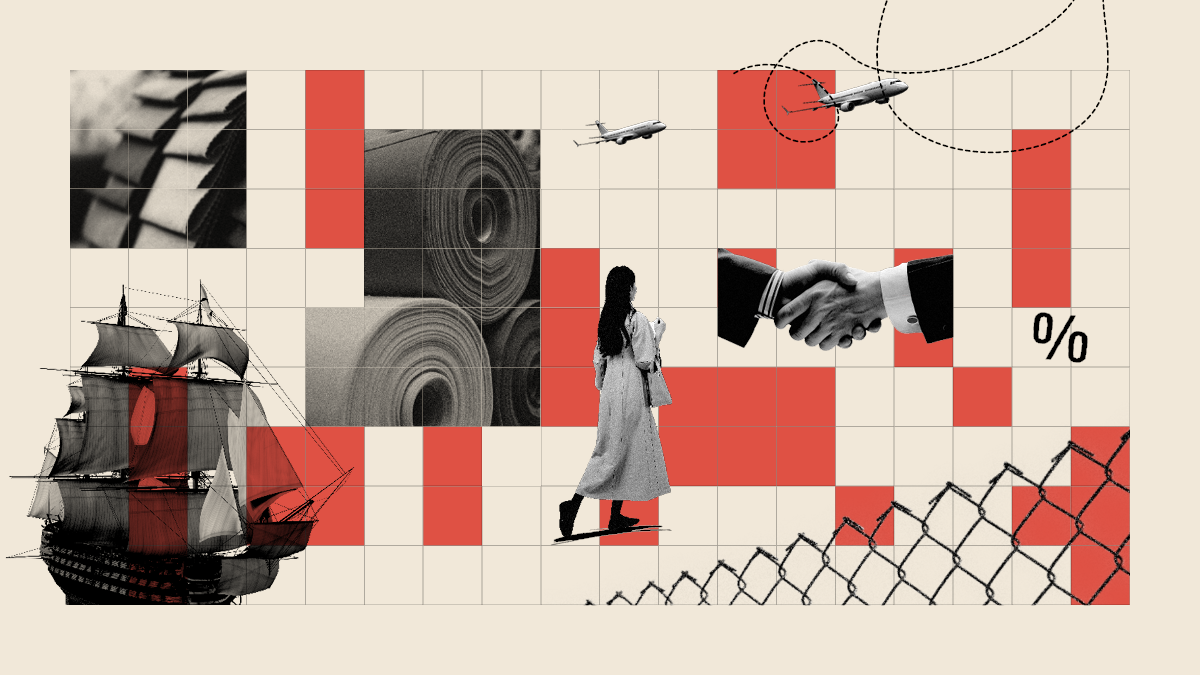

The international fashion industry moves at the pace of consumer trends and also of sourcing. In the last six years, the international sourcing map has entered into crisis, with disruptions such as the pandemic, the Red Sea crisis or the tariff revolution provoked by the president of the United States, Donald Trump. In this new Insight, sponsored by Sevica, Modaes analyzes the current situation of sourcing in fashion, a sector that plays on a new board with geographical changes, means of transport and customs.
Read here the Insight
Sourcing, the new world board.
Day zero of the current world trade order has a name and a surname: October 30th, 1947. At that time, more than 20 countries signed the General Agreement on Tariffs and Trade (GATT). The beginning of a new order, at least for the time being, too: April 2nd, 2025. Known as Liberation Day, on that day U.S. President Donald Trump put an end to nearly 80 years of the principle of reciprocity in international trade. In the construction and subsequent reconfiguration of trade, textiles have played a particular role in the history of tariffs, a key role that has not disappeared today.
“Trade and foreign policy have always been linked throughout history,“ advocated former World Trade Organization (WTO) Deputy Director Alan Wolff in 2018, adding that, in fact, “foreign policy has often been shaped to advance trade interests.“ No wonder, then, that the end of World War II was the main driver of trade liberalization. At a time when international relations were recovering from one of the greatest crises in history, trade emerged as the main lever of global growth and reconstruction in the Western world.
International trade began its modern development after World War II
The germ came with the Marshall Plan, the U.S. aid program for the reconstruction of the Old Continent after the war, with the aim of “facilitating and stimulating the growth of international trade through necessary measures, including the reduction of barriers to such trade”. In the same year, 23 countries signed the GATT in Geneva, a pact in which the signatory countries undertook to systematically reduce tariffs for all other countries, on the premise that the others would do the same.
During the following years, this wave of liberalization grew and gained followers, until its culmination in the so-called Tokyo Round, held between 1973 and 1979, in which more than a hundred countries participated. The GATT had thus gradually expanded, not only to new countries, but also to more products, accompanying years of recovery and economic growth in today’s major economies.
On January 1st, 1995, four years after the demise of the Soviet Union, the history of world trade underwent another historic change with the creation of the WTO, the biggest reform since the end of World War II. The organization, once again headquartered in Geneva, with more than 150 member countries, emerged as the successor to the GATT, with the aim of establishing the rules of the global trade game, but now not only for manufacturing, but also for trade in services and intellectual property.
The new entity was thus adapted to the global economic reality, where the weight of manufactures was shared with that of other types of goods, and the WTO had to promote new rounds of negotiations between countries. Today, the organization is made up of 166 members that, in total, represent 98% of world trade.
Although it has been successful in its expansion thanks to the end of the Cold War, its great unfinished business has been to generate new rounds of negotiations signed by all member countries and covering new products, as evidenced by the almost 25 years that the agreement known as the Doha Round has been in force. Given the impossibility of moving forward with this new pact, the WTO has focused its work on supervising compliance with existing agreements.
On the eve of the WTO’s 25th anniversary, the Covid-19 pandemic shook not only global normality, but also the world trade order. The closure of borders for health reasons also brought an end to the constant supply of goods from Asia to the West, of services between Europe and the United States and of goods between the global South and North.
Little by little, the GATT expanded to include more countries and products, until the birth of the WTO was formalized
The latest disruption, however, has come at the hand of a political conflict, with the arrival of Trump in the White House. The US president emerged victorious in the elections at the end of 2024, after months of election campaigning in which he promised the revival of domestic industry mainly through tariffs. Finally, and after months of speculation, on April 2nd, 2025, the president made good on his promise and announced the imposition of import duties on imports from almost every country in the world.
Trump’s decision then marked the end of the era of international trade expansion (which, however, had long since seen its growth stagnate, as reflected in the inability to sign global agreements). The principle of reciprocity, whereby countries lowered their barriers to entry in favor of others doing the same, has now been turned on its head: if the United States imposes tariffs, China responds with the same decision.
This, however, has nuances, as Trump uses his threats as a negotiating strategy, aware of the effects that a closure of its borders to imports may have on US inflation, but confident that the threat will be enough leverage to start negotiating. Proof of this is the trade pre-agreement reached by the United States and China a few weeks ago, which has significantly reduced US tariffs on the Asian power in exchange for Chinese concessions in key sectors.
Textile limbo
Within this framework of trade openness generated after the signing of the first GATT, fashion lived in limbo between protectionism and openness for decades. The industry’s first exception came in 1961 in the form of an agreement to limit cotton exports, with the aim of limiting the expected flood of cotton from Asian countries.
The rule ended up being extended until 1974, until it was finally replaced by the Multifiber Arrangement (MFA), a framework that would become synonymous with textile protectionism, mainly in Europe. This new exception, which lasted until 1995, allowed countries to impose unilateral limits on imports if they considered that these would endanger local industry, and was used almost exclusively by the United States, Canada, Austria, Finland, Norway and the European Community.
In practice, this system broke the principle of reciprocity and equal treatment between trading partners, the basis on which international trade had been built up to that time, and set specific quotas for each exporting country.
Finally, in 1995, and already within the framework of the WTO, this proto-agreement was replaced by the Agreement on Textiles and Clothing (ATC), with one element to highlight: “it is the only WTO Agreement that provided for its own destruction,“ the organization itself reports. The new framework granted a ten-year period to gradually dismantle the restrictions and reincorporate textiles into the general free trade regime.
Since 2005, with the end of these exceptions, fashion has become a global business, which for twenty years has undergone a liberalization that has reshaped the map of sourcing and employment linked to the production of textiles and garments.
With the awakening of protectionism, however, fashion has quickly returned to the spotlight. Shortly after the first U.S. announcement to impose tariffs on the European Union, first, on steel and aluminum imports, a sector considered strategic by Trump, Brussels responded with its first package of countermeasures, based on its own levies on key products, including textiles.
In total, the EU executive (which, following the trade pact with the United States, has not ended up implementing the tariff measures), expected to reach a value of €90 billion, based on a selection of products that would “rebalance” the trade balance with the American power.
However, a reversal of the globalization of an industry such as fashion clothing is unlikely, even if new quotas and tariffs were to be set. Europe lacks the industrial base and manpower to massively revive (in volume) a low value-added, labor-intensive industry which, because of these conditions, is one of the first to be set up in developing countries.
Related content

Birkenstock projects double-digit growth through 2028 with renewed strategy
29 ene 2026 - 11:16

Levi Strauss Boosts Profitability: Dodges Tariff Impact and Triples Earnings
29 ene 2026 - 11:15

H&M keeps its finger on the pulse and earns 4.6% more at fiscal year-end
29 ene 2026 - 11:10

Gordon Brothers Takes Over LK Bennett, Sets Stage for Global Expansion
28 ene 2026 - 12:33
Latest news
Birkenstock projects double-digit growth through 2028 with renewed strategy
29 ene 2026 - 11:16
Levi Strauss Boosts Profitability: Dodges Tariff Impact and Triples Earnings
29 ene 2026 - 11:15
H&M keeps its finger on the pulse and earns 4.6% more at fiscal year-end
29 ene 2026 - 11:10
Gordon Brothers Takes Over LK Bennett, Sets Stage for Global Expansion
28 ene 2026 - 12:33