Nike’s Downfall: Insights for Fashion from the Sports Titan’s Defeat
With declining sales and a disengaged workforce, what has prompted the sports behemoth to falter, and what insights can be gleaned from a brand struggling to connect? This marks the latest chapter in Nike’s ongoing challenges.
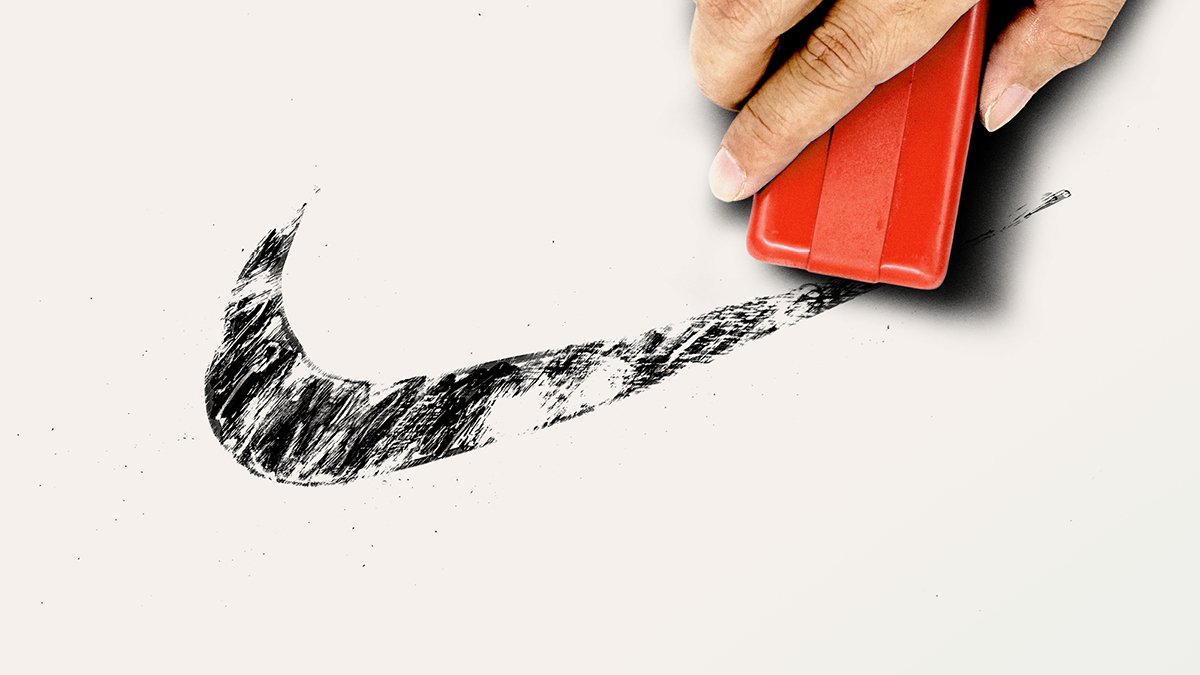


Winning isn’t for everyone. In June last year, when the world’s eyes were on Paris for the Olympic Games, Nike launched its traditional campaign. With narration by actor William Dafoe, athletes like Kobe Bryant, LeBron James, Serena Williams or Kylian Mbappé showed what it’s like to compete and wondered if they are bad people because of it. But in the ad, Nike left out one of its stars, Kevin Durant, who, despite having worn the swoosh jersey for two decades, did not hesitate to explode on social networks: “@nike tell me, Am I a bad person????“, he wrote next to images with the Olympic gold around his neck. Nike is no longer untouchable, neither the leader who does everything right nor the one who signs the best. With sales down and consumers and, above all, employees falling out of love with the brand, what has led Nike to stop winning and what can be learned from a giant whose moves no longer work?
June 28, 2024 will be remembered for years by Nike employees and shareholders. In a single day, the company lost 21% of its stock market value, making it the worst one-day performance in its history and taking $28 billion in valuation with it. The markets reacted very negatively to the fourth-quarter results for fiscal 2023, in which Nike anticipated a drop in sales in 2024. What did Nike do? A few days later, it announced the introduction of a line of sneakers at one hundred dollars in different markets around the world. This move, totally defensive and far from the courage of the past, only made it clear that things had changed at Nike. John Donahoe, its CEO, became the target of all criticism for the decisions made and the changes introduced in only four years of management, and would end up blowing up just three months later: on September 19, Nike announced the dismissal of Donahoe and the appointment of Elliott Hill, a veteran executive that the group rescued from retirement, as the new leader, with the mandate to undo the road travelled, resume the strategy of the past and, above all, to be the reincarnation of the guardian of Nike’s essences: its founder, Phil Knight.
Although it may seem otherwise, this is not the first crisis in the history of Nike, which despite its low hours remains the undisputed leader in the sports segment, with twice the size of the number two, Adidas, 20% more sales than Inditex or above the fashion division of LVMH, with locomotives such as Louis Vuitton. One of the first crises occurred in the 1980s. In the letter to shareholders in the 1984 annual report, Phil Knight, at that time still Chairman and CEO of the company, said: “(George) Orwell was right: 1984 has been a tough year. After a decade of increasing sales and profits, we have seen our results fall by 29%. Several factors have affected us. Our domestic footwear market is declining, fleeing from athletic looks to a new demand for fashionable styles. These changes have resulted in a devaluation of our stocks three times higher than in 1983. But like many of our athletes, who have faced adversity and won, we are fighting back.“

And fight he did. That adverse moment, told with a dose of fiction and a lot of reality in the movie Air (directed by Ben Affleck and starring Matt Damon), resulted in a move that would revolutionize the sports industry forever. Nike was then a mere running operator that had grown thanks to the jogging boom but wanted to enter the sport of the masses, basketball, and played the game on a last-second triple: the signing of Michael Jordan, a rising star who, at the time, was in love with Adidas.
Knight closed his eyes, listened to his team and gambled on signing Jordan, for whom he created a new brand of his own and for whom he paid fines to the NBA for being able to use any color other than white on playing shoes. With this move, Nike forever changed the sports industry, revolutionizing the way marketing was done by elevating athletes to global icons.
If in the 1984 memoir the image of Phil Knight accompanying the letter to shareholders showed a serious CEO, in the 1986 memoir he appeared with a grin from ear to ear. “The company has been in business for 22 years and 1986 has been the best in our history,“ wrote Nike’s founder after a year in which the group had surpassed $1 billion in sales for the first time in its history. A year earlier, in 1985, Nike had introduced the Air Jordan.
The second critical moment in Nike’s recent history came in the late 1990s, when Nike realized that the product was not enough. The Beaverton (Oregon) group had already become the world’s largest company in the sports segment (it did so in 1989), thanks in part to high investment in marketing (which in 1989 had increased by more thanThe Beaverton (Oregon) group had already become the world’s largest company in the sports segment (it did so in 1989), thanks in part to its high investment in marketing (around $45 million in 1989) with Michael Jordan and Spike Lee, and to the impact of Just do it, created by the company’s head agency, Wieden+Kennedy, and introduced in 1988. He had also become an expert in crisis management, such as the launch of the successful Just do it (inspired by the last words of the serial killer sentenced to death in 1977, Gary Gilmore) or the one provoked by an article in Life magazine published by the company’s own agency, Wieden+Kennedy, in 1988. an article in Life magazine in 1996 denouncing the company for employing children under the age of six to sew soccer balls in Pakistan.
Although it may seem so, the current crisis is not the first in Nike’s history. The first took place in the 1980s, in reaction to which it ended up signing Michael Jordan, a move that forever changed the sports industry
Nike’s crisis in the late 1990s came not from outside, but from within. Although it had had previous retail experience, in 1990 the company launched its first Niketown store, located in Portland, Oregon. The group had realized that knowing how to make the best product, the most eye-catching marketing and the most effective sales strategies was not enough in the new decade: Nike lacked retail and went out into the market to find the best.
In 2001, the U.S. multinational brought Jane Jackson onto its board of directors and, eight years later, ended up creating for her the position of president of direct-to-consumer, with authority over company-owned stores, franchises and digital. Jackson had the experience of having worked in the largest retail companies in the United States, from Walmart to Gap, via The Walt Disney, Saks and Victoria’s Secret. Alongside her, a legion of retail executives from the world’s leading companies joined Nike, which brought in the best talent in the market and blended it with the product and brand knowledge it already had in its ranks.
The next turning point for Nike would come in the 2000s. The group was already an experienced retailer and had added a new skill to its capabilities, but it lacked another that had just appeared as a result of the changing times: digital. In 1999, the company launched its online store, again ahead of its competitors: Foot Locker in 2000 and Adidas in 2006. It did so to sell directly to its customers, but, as when it entered retail, it realized that it was not an expert at it. A company then eminently analog and brick-based, it went out into the market to find the best. Where did he look? Silicon Valley. Experts from companies like Google or Apple (in 2005, Tim Cook, Apple’s CEO, joined the board of directors) brought their talent to Nike, but mixed it with what was already in-house. Nike knew how to do product, marketing, sales, retail and, now, also online.
Nike continued to move forward, like a steamroller, in the sports market. No one was able to overshadow it. It ousted Reebok, ousted Adidas and bought: in 2002 it took over Hurley, specializing in surfing, and in 2004 it took control of Converse for 309 million dollars. All of Nike’s previous changes had been led by the charismatic and histrionic Phil Knight, who in the same year that his company bought Converse, stepped down as president and CEO, although he remained at the head of the board.
After several years of searching for a successor, Knight opted for an outsider and handed the keys to the locker room to William Perez, a Cornell-educated Ohio native who came to Nike from retail, where he had been CEO of Johnson & Son for eight years. Nike’s product soul and strong corporate culture (embodied in its founder, who didn’t quite want to let go of the helm) didn’t mesh with Perez’s operations one, who just over a year after his appointment resigned from the position. “Phil and I found ourselves completely at odds on some aspects when it came to running the company and its expansion,“ Perez said in his resignation. “Unfortunately, the expectations that Bill (William Perez) and I had when he joined the company a year ago have not been realized as we had hoped,“ Knight said bluntly. Nike, moreover, was also being overtaken by the impending merger between two of its biggest rivals, Reebok and Adidas.
With Perez’s resignation, the reins of Nike were taken over by Mark Parker, until then co-president of the company and with a career of almost thirty years in the company. A man of the house, a keeper of the essences to lead Nike. Born in Poughkeepsie, New York, in 1955 and with a degree in political science, Parker joined Nike in 1979 as a footwear designer, a division in which he worked his way up to become global vice president. He then moved to the presidency of the Nike brand, from where he jumped to the group. When he took over as CEO, he was 50 years old and had been at Nike during its peak commercial and financial years. If the founder highlighted Perez’s “differences”, Parker’s “creativity, innovation and growth”.
In his letter to shareholders, Knight described 2006 as a “rare” year. Group sales were close to $15 billion and earnings per share were up 18%, but the share price fell 5% in twelve months. “It all starts in the corner office. It seemed to me for a moment that we could do well with a perspective from outside that office. But in the end I guess we’re just different. We’re a different industry and we have a very different corporate culture. We are now led by a man who has dedicated his entire career to this company,“ the entrepreneur justified himself.
Based on the results, Parker’s appointment was the right decision. From 2006 to 2019, the company nearly tripled in size, from $14.954 billion in revenue to $39.117 billion, and net income rose by the same proportion, from earning $1.392 billion to $4.029 billion.
The company not only increased its results, but also its market positioning. The giant reached an overall share of around 30% of the global footwear market, with aggressive and constant investment in advertising and communication (including contracts with athletes, media investment, brand campaigns and events), which in fiscal 2019 rose to 3.753 million, up 5% from 2018 and equivalent to about 10% of sales. In 2018, Nike signed, in fact, one of the most controversial and effective campaigns in its recent history, when it starred athlete and activist Colin Kaepernick kneeling during the U.S. anthem as a form of protest against police violence and racial discrimination in the country. Although it had its detractors, Nike reaffirmed its brand identity.
But Mark Parker’s time also came to take a back seat, a vital moment that coincided with a new sense of need for reinforcement at Nike. In 2019, the term Retail Apocalypse figured in every conversation in the retail industry. Although the term has its origins in the crisis that shopping malls were experiencing in the United States (in which debt was an essential component), it became the perfect crutch to summarize the accelerated shift of sales from the physical to the digital world. Once again, Nike went in search of talent, but this time it found it closer to home.

In 2014, the group had added John Donahoe to its board of directors, with technology as one of his core areas of expertise. Born in Evanston (Illinois) in 1960, Donahoe began his career at Bain&Co, a consulting firm that he went on to chair. He later jumped to Ebay, which he also chaired, between 2008 and 2015, before moving on to hold the same position at digital services company ServiceNow from 2017 to 2019. Despite the fact that Knight had acknowledged in 2006 after the Perez fiasco that “we’re just different,“ Nike was once again tempted to turn to an outsider.
The beginning of the turnaround
On January 13, 2020 (a few months before Covid-19 broke out as a global epidemic), John Donahoe became CEO of Nike. After the traditional tour around the world to visit Nike teams (the current CEO also did so right after taking office), Donahoe explained his roadmap to the staff via email. To achieve a much more digital and efficient company, Nike would make three decisions: first, to move from a category-by-sport approach to a category-by-product approach (with impact on organization and customer outreach); second, to become a direct-to-consumer company, drastically reducing the relationship with retailers (with a significant reduction in the number of retailers); and third, to become a direct-to-consumer company (with a significant reduction in the number of retailers).The third is to change the marketing model, centralizing all decisions, eliminating the local approach and moving to a strategy based solely on data and in search of digital profitability.
According to several former Nike executives, Donahoe, accustomed to Ebay’s modus operandi, found Nike’s decision-making process complex, slow and inefficient. For example, for the signing of a breakout European soccer player, Nike would have required four people in agreement (the director of soccer in Europe, the director of the soccer unit, the territorial director, and the director of sports marketing) before reaching the CEO for final approval. To end this process (which, after all, was similar to the one that took place when Jordan was signed), Donahoe completely reorganized the group’s structure. As his right-hand woman, he appointed Heidi O’Neill, who had a long history with the company, but was now president of consumer and marketplace.
The restructuring took place in two waves, starting in August 2020 and ending in mid-2021, affecting first the United States and then the rest of the world. Nike ended its subsidiaries, which gave it connections to markets (key to localized marketing), and centralized decisions in Oregon. Teams went from being organized by sport disciplines and led by people with extensive knowledge of each of them to being structured according to gender and age (men, women and children), just as a large retail group such as Inditex or H&M does. As a result of this change, thousands of people were laid off in six months, putting an end to the knowledge in soccer, basketball or fitness harvested over the years.
The changes in the structure, the successive waves of layoffs, the centralization of decisions and the cornering of the product in front of efficiency have put an end to what made Nike different
As an example, the case of Spain, where this movement resulted in an employment regulation plan (ERE) to lay off 40% of its workforce applied in mid-2021, after which Spain was left without a general manager and all decisions became dependent on the Netherlands, like those of the rest of the subsidiaries. Ignacio Serrat was the last general manager of Spain, an office that is now headed by Albert Baronet, senior director of sports marketing for southern Europe, with no hierarchical ascendancy over the team.
In 2019, sales to wholesale customers accounted for more than 68% of the total business, with $25.423 billion, compared with just over $11.7 billion contributed by Nike Direct. The supremacy of direct-to-consumer over wholesale was evident from the arrival of Donahoe: Nike broke agreements with hundreds of sports equipment distributors, from the world’s largest, starting with Foot Locker, to a myriad of local chains that gave the swoosh brand market penetration. Not only did it break decades-old agreements, but in product distribution it prioritized, of course, its own channels. In two years, wholesale reduced its weight in sales by seven points, the same as Nike Direct.
But if reducing the weight in percentage was relatively easy, increasing sales through direct channels in volume was not so easy, so Nike also changed its marketing strategy: from creativity, courage and product and brand positioning, to a strategy focused on performance marketing. In order for the website and app to achieve the objectives set out in the strategic plan, resources were allocated from the marketing area: sports marketing, brand management and retail actions lost out. In fiscal year 2022, after the freeze on expenses resulting from the Covid-19 strike, “demand creation spending” came to represent 8% of total turnover. The profile of marketing team members changed, pushing traditional brand builders to the sidelines.
In previous new hires at Nike, the newcomers had blended in with the veterans and the corporate culture had survived, but with Donahoe this was not the case. The abruptness of the change of strategy together with the personnel adjustments created a feeling of superiority of some over others. This phenomenon also reached the finance area. In a company like Nike, company sources explain, the pressure from Wall Street had to be made compatible with a company in which “it mattered little how much was spent if the asset (the athlete, for example) was considered good”.
Andrew Campion, Nike’s CFO from 2015 to 2024, was replaced by Mathew Friend, promoted to the position by Donahoe from the strategy area. Friend accelerated decisions that prioritized finance over product. One example was the management of icons, i.e. bestsellers. Until then, Nike managed its bestsellers by balancing them with launches, but the pressure for short-term results progressively reduced the weight of innovation. The product voice was silenced in favor of finance.
With Donahoe and his trusted team introducing all these changes starting in 2020, the Covid-19 crisis seemed to endorse them. With all stores closed and potential shoppers confined, the belief that physical retail was dead took hold. Likewise, telecommuting made efficiency take precedence over team collaboration. In fact, Nike’s results in the years affected by the pandemic were record-breaking: in the year ending May 2020, sales fell by only 4%, and in the year ending twelve months later, they soared by 19%, rising by almost 5% in the year ending May 2022.
But the seams came apart with the presentation of the results ended May 2024. Nike closed the year with the slowest growth in a decade, a bad moment that was confirmed with the presentation of results for the year ended May 2025, closed with a 10% drop in sales and a 44% plunge in profit. What had happened? An accumulation of bad decisions that led Nike to stop being unbeatable. The exit from the wholesale channel was perhaps the most obvious: in sports, distributors (Foot Locker, Dick’s or JD Sports) are still relevant among consumers, who go to their stores in search of the product of their choice. Nike, which used to apply the maxim of winning in any channel, is no longer there, so they choose another.
An eminently B2B company suddenly pivoted to B2C, leading to purchasing and product errors and raising stock, for which it resorted to discounting and margins were eroded
The void left by Nike has been exploited by other brands, such as On or Hoka, which are now top of mind for consumers, thanks also to the fact that Nike has ceased to be the inspirational brand because it has changed its marketing strategy and has let its marketing strategy slip in the last few years.Nike has lost iconic sponsorships such as Lamine Yamal (now with Adidas), Manchester City (with Puma) and Stephen Curry (Under Armour). According to Euromonitor data, Nike’s global market share for apparel and footwear has gone from 17.1% in 2022 to 16.4% in 2024, although it remains well ahead of Adidas (9% in 2024), Anta (3.7) and Puma (3%).
The shift from wholesaler to retailer has also taken its toll on Nike’s profitability. In a company used to an eminently B2B business, having to decide, overnight, what, how much and when to manufacture and where to place the product ended up generating errors that caused inventories to skyrocket. To combat this, the company became aggressive in discounting, also spurred by the greater weight of online, where price is a relevant vector of sales. As a result, Nike’s gross margin fell from 44.7% in 2019 to 42.7% in the last fiscal year.
But, above all, all these changes had a consequence that will be hard to lift: the erosion of corporate culture. The changes in the structure (removing weight to figures as relevant as the creative director or the brand director), the successive waves of layoffs, the centralization of decisions in the ivory tower of the Beaverton headquarters (almost 5.000 kilometers from New York and far away from London, Paris or Shanghai), with little multicultural profiles, and the cornering of the product in front of efficiency have put an end to what made Nike different. “Before, you worked at Nike and you felt that you owed something to the company, you wanted to be the best so that the company would be the best, nowadays people feel that Nike owes them something,“ explains a former executive.

The correction
“I’m a big fan of Elliott. He’s exactly the right person to lead Nike now.“ If Michael Jordan, one of the greatest athletes of all time and, to top it off, Nike’s biggest star, talks this way about Elliott Hill it must be that the swoosh group has got the right person to turn him around. But Hill has everything to prove and doubts arise in the market as to whether a man of his age and representative of the brilliance of another era is the best fit for the current moment. If Parker was the reincarnation of the founder and his values when Perez’s venture went wrong, it is now clear that Hill must play the same role.
With Hill’s new roadmap, unveiled last March, Nike is back out to win. The strategy, dubbed Win Now, is based on five sports disciplines, three countries and five cities. Running, basketball, soccer, soccer, training and sportswear as priority sports, starting in the U.S., China and the U.K. and focusing on New York, Los Angeles, London, Beijing and Shanghai.
These sports, countries and cities will be attacked starting by reigniting “the winning team culture” (in Hill’s words), recapturing Nike’s storytelling, generating a “complete product portfolio” (which should offset the “headwinds of classic franchises”), returning to partnerships with wholesalers and regaining the connection with local athletes. In short: roll back the decisions made by the previous CEO and return to the Nike of old. From the fifteen direct reports he inherited from Donahoe, Hill has changed to eleven.
From his still-active reign in the sports industry, Nike has already begun to go back on the offensive. But the road will be long. Regaining retail space will be a matter of deals. Getting back to being the most innovative brand with the most inspiring marketing will require more work, not only in terms of time but also in terms of lost talent. It is also possible to correct structures that have been overly focused on responding to the mirage of digitalization or any other change that has taken place. But, without a doubt, the most difficult thing will be to recover the values that Phil Knight has shown year after year. Marc, the fictitious name of a former Nike executive in Europe, explains: “When I joined, I thought Nike’s advantage was the product; later I thought it was the power of communication and marketing; then sports marketing, with high barriers to entry. When I left I realized that Nike’s advantage was its culture: the competitiveness of sports well understood. It’s gigantic what culture can do.
Related content
Tariffs Push Nike’s Costs Higher, With $1 Billion Hit on the Horizon
30 jun 2025 - 06:00
Nike Reports 44% Profit Decline and 10% Sales Drop Amid Ongoing 2024 Slowdown
27 jun 2025 - 06:37
Nike Streamlines Operations: 775 Job Cuts at U.S. Distribution Centers
27 ene 2026 - 08:20

Nike Investigates Potential Data Leak Following Cyber Incident
26 ene 2026 - 19:13
Latest news
Birkenstock Charts Robust Growth Path to 2028 with Fresh Strategy
29 ene 2026 - 11:16

Levi Strauss Boosts Profitability: Dodges Tariff Impact and Triples Earnings
29 ene 2026 - 11:15
H&M Holds Steady: 4.3% Profit Surge in 2025 Approaches €1.06 Billion Mark
29 ene 2026 - 11:10

Gordon Brothers Takes Over LK Bennett, Sets Stage for Global Expansion
28 ene 2026 - 12:33