JD Sports Sees Operating Profit Dip in H1 Despite 18% Sales Surge
The British sports fashion retailer has expanded its market share across North America and Europe in the first half of the fiscal year, with sales soaring following the integration of Hibbett and Courir.
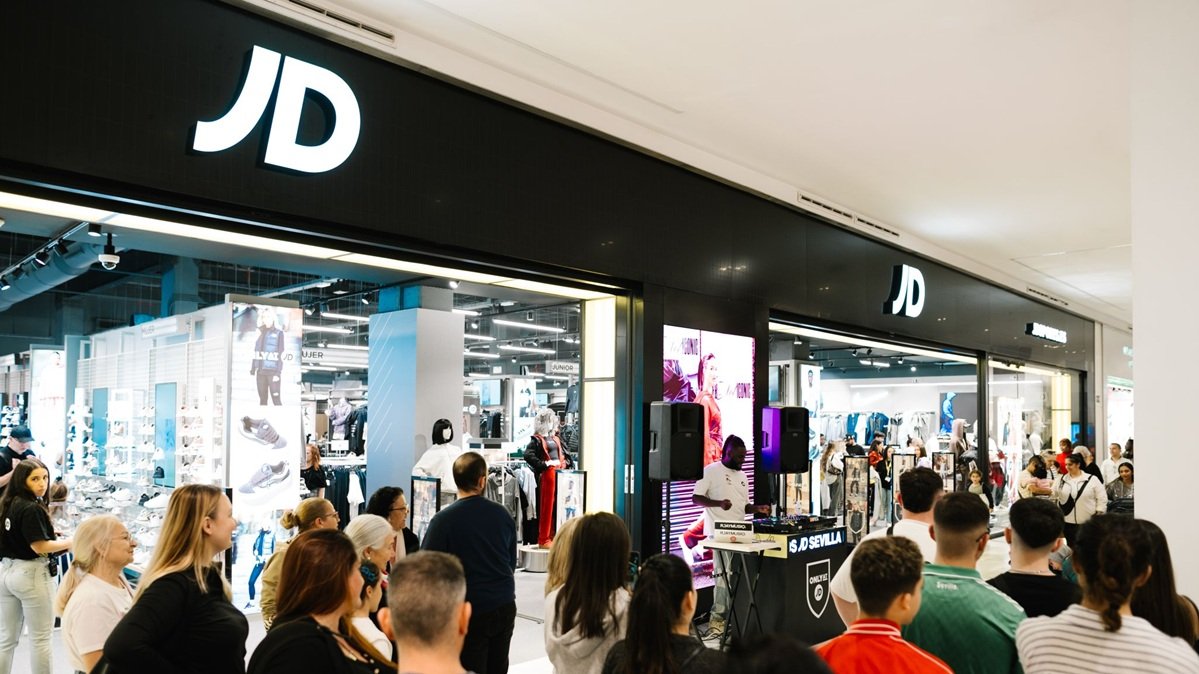

JD Sports resists and maintains forecasts. The British sports retail group closed the first half of the year with a drop in operating profit, pressured by weak consumer spending and the transition in the footwear product cycle. Despite this, the company has gained market share in North America and Europe and expects to meet its targets for the full year.
Between February and the beginning of August, JD Sports increased its sales by 18% to 5.94 billion pounds ($8 billion). At constant exchange rates, the increase was 20%, driven mainly by the recent acquisitions of the Hibbett chain in the United States and Courir in France.
Organic growth, excluding corporate operations, was limited to 2.7%. By markets, North America generated 39% of sales, Europe 32%, the United Kingdom 25% and Asia Pacific 4%. In Europe, the company highlighted the resilience of sales in the Iberian Peninsula, Greece and Cyprus.
On a like-for-like basis, the group recorded a decline of 2.5% in the network as a whole. The decline was 3.8% in North America, 3.3% in the United Kingdom and 0.3% in Europe, while Asia Pacific closed the half-year with an increase of 2.4%.
JD Sports reported a drop in margins and profit in the first half of the year
The group’s operating profit fell by 8.2% to 369 million pounds ($498 million), with a margin of 6.2% compared to 8% in the same period last year. Profit before tax and exceptional items was 351 million pounds ($474 million), down 13.5%.
The company also cut its gross margin from 48.6% to 48%. At the same time, JD Sports said that adjusted net profit was pressured by weak consumer spending in the UK and the slowdown in footwear categories, although it recorded a better performance in the textile line.
By division, the JD brand generated 3,674 million pounds sterling in sales, down 3% like-for-like, while the complementary concepts (Hibbett, DTLR, Shoe Palace and City Gear in North America, along with Courir and MIG in Europe) generated 1,567 million pounds, down 2.4% like-for-like. The sports and outdoor business was flat at 699 million pounds sterling.
Régis Schultz, CEO of JD Sports, pointed out that the group “is facing a complex consumer environment”, but highlighted the progress made in efficiency and cost control. The executive stressed that the company has recorded a “solid performance” in the textile line, which grew by 6% to 1.6 billion pounds.
The company boasts new logistics capacity and will focus on textiles
The company has also accelerated its investment in logistics. In Europe, it is about to start automating its new distribution center in Heerlen (Netherlands), while in the United States it plans to activate a West Coast hub for the JD and Finish Line chains before the end of the year.
Footwear, which now accounts for 62% of turnover after the integration of Hibbett and Courir, has suffered the transition in product cycles, although the company has highlighted the good evolution of performance lines and new references.
Looking ahead to year-end, JD Sports expects the impact of tariffs in the United States to be limited, although it remains cautious about the macroeconomic environment. The company has pointed to risks stemming from pressure on disposable income, labor uncertainty and the slowdown in the footwear product cycle. Despite these challenges, the group expects 2025 adjusted pre-tax profit to be in line with current market forecasts.
Related content
Birkenstock projects double-digit growth through 2028 with renewed strategy
29 ene 2026 - 11:16

Levi Strauss Boosts Profitability: Dodges Tariff Impact and Triples Earnings
29 ene 2026 - 11:15
H&M keeps its finger on the pulse and earns 4.6% more at fiscal year-end
29 ene 2026 - 11:10
Gordon Brothers Takes Over LK Bennett, Sets Stage for Global Expansion
28 ene 2026 - 12:33
Latest news
Birkenstock projects double-digit growth through 2028 with renewed strategy
29 ene 2026 - 11:16
Levi Strauss Boosts Profitability: Dodges Tariff Impact and Triples Earnings
29 ene 2026 - 11:15
H&M keeps its finger on the pulse and earns 4.6% more at fiscal year-end
29 ene 2026 - 11:10
Gordon Brothers Takes Over LK Bennett, Sets Stage for Global Expansion
28 ene 2026 - 12:33