IMF Revises Global Growth Prospects Upward Amid Tariff Reductions
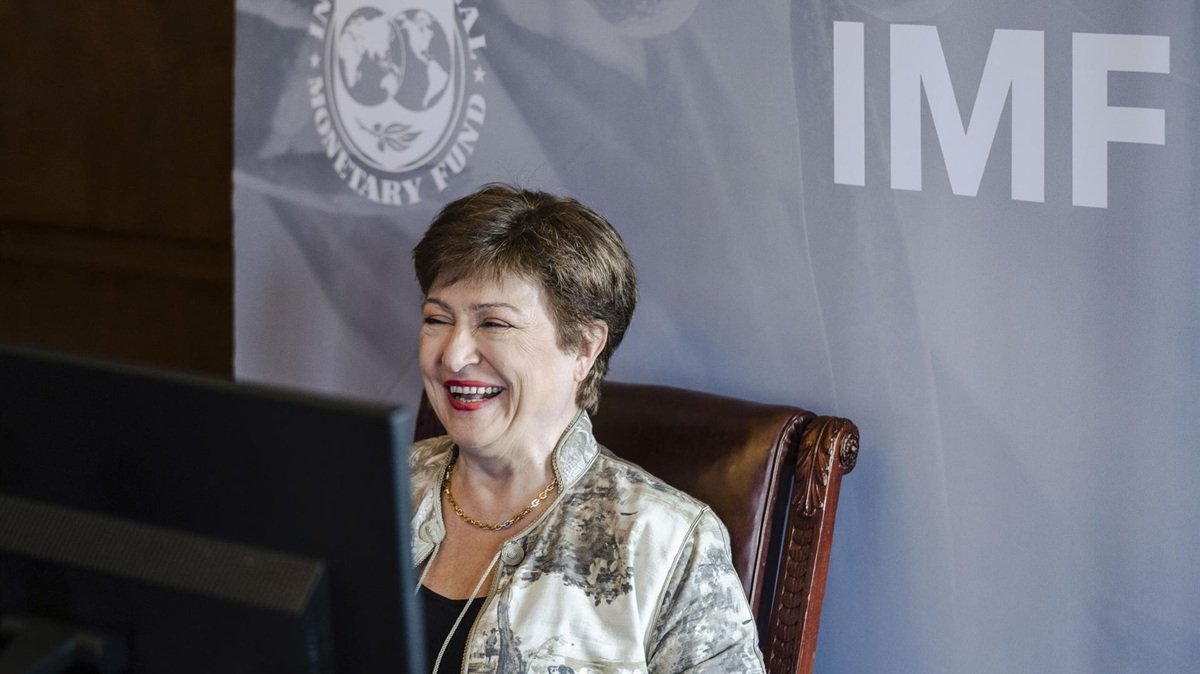


The International Monetary Fund (IMF) has slightly upgraded its global growth forecasts for this year and next as a result of lower tariff rates than announced last April between the United States and China. In addition, it highlights the impetus for trade concentration at the beginning of the year in anticipation of levies, along with planned fiscal expansion measures in some major jurisdictions.
Thus, in the summer update of its macroeconomic projections, the IMF forecasts a slowdown in global growth from 3.3% in 2024 to 3% this year and to 3.1% by 2024.This is below the historical pre-pandemic average (3.7%), although above the April forecast, when it anticipated a global GDP expansion of 2.8% in 2025 and 3% in 2026.
The international institution stresses that the upward revision for 2025 is quite large, as it is largely due to an anticipated strong front-loading of international trade in anticipation of the tariffs coming into force, as well as the effect of a lower effective global tariff than expected in the spring and an improvement in global financial conditions.
The IMF forecasts a slowdown in GDP from 3.3% in 2024 to 3% this year
In this regard, the U.S. effective tariff rate underlying the July projections is 17.3%, down from 24.4% in the April forecast, while the corresponding effective tariff rate for the rest of the world is 3.5%, down from 4.1% in the previous projection. While assuming that economic policy uncertainty will remain high this year and next, the IMF anticipates near-term fiscal stimulus in major economies such as China, Germany and the United States.
In the US case, the budget blueprint pushed by Donald Trump is expected to increase the fiscal deficit by about 1.5 percentage points of GDP in 2026, but tariff revenues are expected to offset about half of the increase, although over the medium term, despite spending cuts and sizable tariff revenues, US fiscal deficits are projected to be larger than projected in April.
The IMF’s new projections anticipate growth in advanced economies of 1.5% in 2025 and 1.6% in 2026, in both years a tenth better than forecast, including an expansion of U.S. GDP, with the U.S. economy expected to grow by 1.5% in 2025 and 1.6% in 2026, in both years a tenth better than forecast.The new IMF projections foresee GDP growth in the United States, with tariff rates at lower levels than those announced on April 2, of 1.9% this year and 2% next year, an improvement of one and three tenths of a percentage point, respectively.
In this regard, the institution expects a near-term boost through the fiscal stimulus of the approved budget plan, which could boost U.S. GDP by half a percentage point on average through 2030, relative to a base without the implementation of the fiscal package.
Forecasts for the eurozone
For the eurozone, the IMF expects growth to accelerate to 1% in 2025, an upward revision of two-tenths of a percentage point this year, largely on the back of Ireland’s strong GDP in the first half of the year.In the case of the eurozone, the IMF expects growth to accelerate to 1% in 2025, an upward revision of two tenths this year, largely thanks to Ireland’s strong GDP in the first quarter of the year due to a historically high increase in Irish pharmaceutical exports to the United States, while the forecast for 2026 remains unchanged at 1.2%.
Among the euro countries, the institution improves the growth forecast for Germany this year by one tenth of a percentage point to 0.1% and maintains the forecast for 2026 at 0.9%, while for France it confirms an expansion of 0.6% and 1%.In the case of Italy, it expects growth of 0.5% in 2025, a tenth of a percentage point more, and maintains the estimate for 2026 at 0.8%.
The Spanish economy will remain the best performing large developed economy in 2025, with GDP growth of 2.5%, which will moderate to 1.8% in 2026, as projected last April by the IMF.
For emerging and developing economies, the IMF expects growth to be 4.1% in 2025 and 4% in 2026, improving this year’s forecast by four tenths of a percentage point and the following year by one tenth of a percentage point, mainly as a result of the higher expansion anticipated for China in 2025 and China in 2026.In 2025, China is expected to expand by 4.8%, eight tenths of a percentage point more than in April, due to the better growth data for the first quarter and the significant reduction in tariffs between the United States and the Asian giant, while in 2026 an expansion of 4.2% is expected, two tenths of a percentage point better than in April.
In the case of India, the IMF projection points to growth of 6.4% in 2025 and 2026, with both figures revised slightly upward from the 6.2% and 6.3% forecast respectively in April to reflect a more benign external environment than assumed last spring.
In any case, the IMF warns that risks to the outlook remain tilted to the downside, given that the “precarious balance” of trade policy positions assumed in the baseline scenario could be altered and lead to a new one with similar or much higher rates in the event that negotiations fail and an escalation of protectionist measures restarts.
Even if tariff rates remain unchanged from the baseline scenario and no new protectionist measures are introduced, the IMF notes that elevated trade uncertainty could begin to affect activity more strongly if current U.S. deadlines for additional measures expire without durable and comprehensive agreements, slowing investment by affected companies.
On the other hand, an escalation of geopolitical tensions could bring further negative supply shocks to the global economy and shipping lanes and supply chains could be disrupted as commodity prices rise, placing central banks in more difficult choices.
Related content


Birkenstock projects double-digit growth through 2028 with renewed strategy
29 ene 2026 - 11:16

Levi Strauss Boosts Profitability: Dodges Tariff Impact and Triples Earnings
29 ene 2026 - 11:15

H&M keeps its finger on the pulse and earns 4.6% more at fiscal year-end
29 ene 2026 - 11:10
Latest news
Birkenstock projects double-digit growth through 2028 with renewed strategy
29 ene 2026 - 11:16
Levi Strauss Boosts Profitability: Dodges Tariff Impact and Triples Earnings
29 ene 2026 - 11:15
H&M keeps its finger on the pulse and earns 4.6% more at fiscal year-end
29 ene 2026 - 11:10

Gordon Brothers Takes Over LK Bennett, Sets Stage for Global Expansion
28 ene 2026 - 12:33