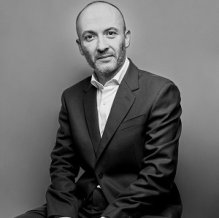
Euratex Leader Dirk Vantyghem Warns: Regulatory Uncertainty Stalls Investment
The CEO of the European Apparel and Textile Confederation (Euratex) warns that the European Commission, in its regulatory role within the industry, risks losing its initial momentum and making changes midway.
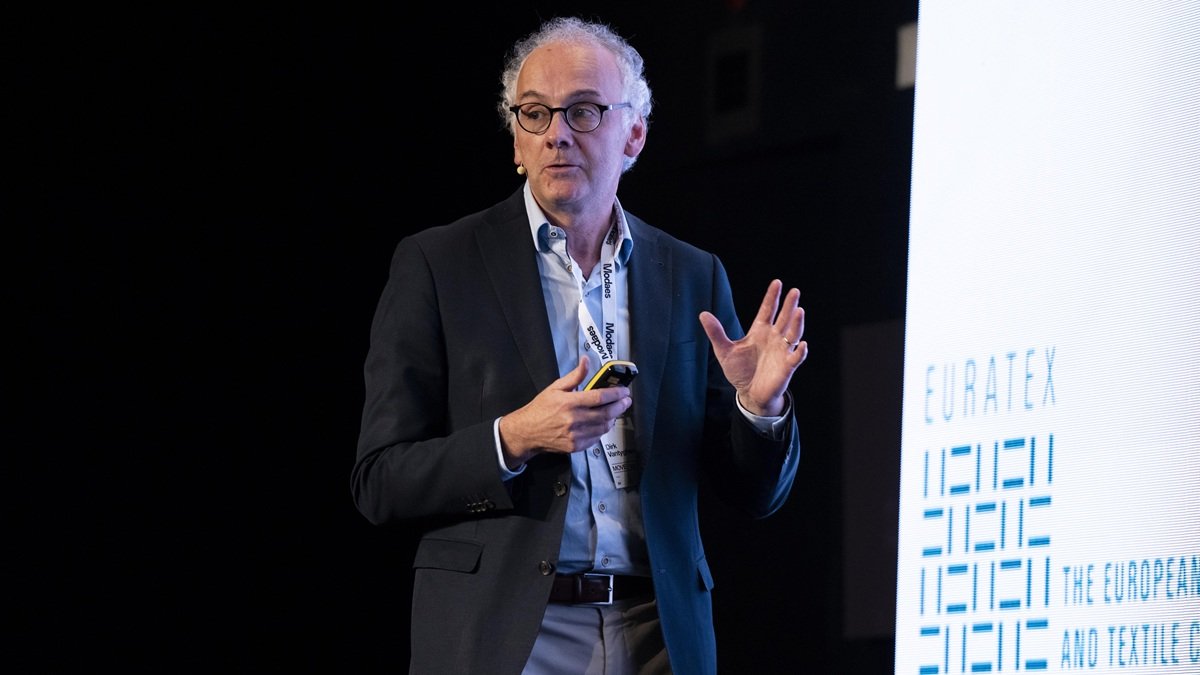


Fashion Sustainability Shot develops in 2025 a new series of interviews with the voices that are at the forefront of entities, associations and employers’ associations that organize the sector in the transition of fashion towards sustainability. Promoted by Modaes and sponsored by Tendam, the series began airing in 2021 and contributes monthly to generate knowledge about sustainability in the Spanish fashion industry. In 2025, Fashion Sustainability Shot seeks to generate new and highly relevant content for the sector, with the participation of representatives of key entities at national and European level.
Dirk Vantyghem, CEO of Euratex since 2019, advocates a common path to sustainability and profitability in the face of the challenge of finding a reward for companies that bet on sustainable product manufacturing and the market’s positive response to these investments. The executive stresses the importance of not “leaving the entrepreneur alone with the effort and good intentions”.
Question: What are now the most urgent risks for the European textile sector?
Answer: Today we are facing a critical situation. On the one hand, many changes are taking place in the regulatory field. The European Union is pursuing a major agenda to develop new regulations and standards for the textile industry, but there are many interruptions. Proposals are made and postponed, which creates a lot of uncertainty for textile entrepreneurs to know what kind of regulations will be decided and when they will come into force. Regulatory uncertainty makes it difficult for companies to decide when and what kind of investment they should make. A second risk is related to global markets, where we all follow what is happening in Washington, with the reactions of China and Europe, which makes it very difficult for textile companies to plan for the future without knowing what tariffs will be applied, when and what the consequences will be, for example, in China. Once again, also in this area there is a lot of uncertainty, which hampers companies’ forecasts and consumer confidence. As a result, the market and demand for textile and apparel products are rather weak. In short, these are turbulent and uncertain times.
Q: Do you see production moving to Europe? Will Turkey or Morocco ever be able to replace the production capacity of Asian countries?
A: Yes, it is true that there is a lot of talk about nearshoring, friendshoring or reshoring, and at Euratex we are working a lot on this. We collaborate with our southern neighboring countries, such as Morocco and Tunisia, with our Turkish colleagues, and also with eastern countries such as Ukraine, to strengthen relations between the EU and with neighboring countries and try to develop an integrated value chain that strengthens the Euro-Mediterranean supply chain for the textile industry. Will this bring all textile production back to Europe and away from Asia? Of course not, and that is not what we are asking for and not what we want, but to slightly increase production in these neighboring countries for some segments of the industry, probably the medium and high end, which would be very welcome. It is not about bringing back all production, but about rebalancing the supply chain so that we are not 100 percent dependent on China, Vietnam or Bangladesh. It is more about spreading the risk and diversifying the supply chain.
“The market and demand for textile and apparel products are quite weak.“
Q: What is the current level of development of the European textile industry in terms of sustainability at the moment?
A: It’s difficult to quantify, but what we see is that many European textile companies are making a big effort to make this green transition in terms of new technologies, investment and new product development, so we see a lot of progress. A few weeks ago we supported for the first time an exhibition on textile recycling held in Brussels, where it was great to see so many European textile companies showing their technology, their ambition and their plans to make more sustainable textile products, garments and technical textiles. There was a lot of good intentions and very positive movement. The challenge, however, is that today the manufacture of more sustainable textiles is not really rewarded by the market. These products tend to be more expensive, with higher investment and production costs. So the challenge is how to reward companies that want to manufacture sustainable products, how to get the market to respond positively to those investments, and not leave the entrepreneur alone with the effort and good intentions.
Q: If the European Commission stops legislating on sustainability, will fashion move forward on its own initiative?
A: That’s a difficult question. It is true that this kind of ecological transition, the Green Pact as we know it, is changing. There are some changes in legislation, a kind of pause, some modifications through the Omnibus initiative. The debate is complex, because without that regulatory impetus, the question is whether brands will decide on their own to move towards selling more sustainable textile products. The fear is that they will not and that, due to competitive pressure, they will not be inclined to make that transition. If regulation slows down, the entire industry’s transition to more sustainable textile products will also slow down. We must be careful that this momentum does not slow down because the regulator is hesitating and introducing changes along the way. Because the market pressure among brands, particularly the pressure from online platforms is so high that it is very difficult for brands to move forward on sustainability, because of the higher cost, while the competition is very high. We need those sustainability regulations, but we need them to be done correctly and well designed.
Q: Is it better to have no regulation or bad regulation?
A: While on due diligence we have seen that things are probably too complicated, burdensome and overlapping between different laws, so we need to fix that. We have to review that regulation, but not abandon it completely: if we do that, the momentum towards sustainable textiles will disappear. It’s about finding a careful balance between keeping the regulatory flow toward greater sustainability and making sure that regulation is done correctly. It’s a question of the quality of the legislation and the timing of when it is passed. We need that regulatory framework to drive the industry toward greater sustainability, and we need it to apply not just in Europe, but around the world. If it only applies to European companies and not to brands and textile companies outside, we will have a problem.
“We need to review that regulation, but not abandon it completely: if we do that, the drive towards sustainable textiles will disappear.“
Q: Is sustainability perhaps the new driver of European industry? Have we missed an opportunity?
A: I think it is too strong to talk about a missed opportunity; the opportunity is still there. In fact, we strongly believe that European textile companies can or should be world leaders in sustainable textiles. We have the technology, the know-how and the entrepreneurial ambition. Sustainability should be a source of competitiveness, but for that we need the right regulatory framework. Creating that framework is complex, it’s not just about developing the legislation, but also about how to implement and monitor it, not only in Europe, but also on products that are manufactured outside and would enter European markets. We are talking about market surveillance and enforcement. We must maintain the ambition to work on this, because such a framework will benefit the competitiveness of our companies, although we recognize that the process is complicated and will take longer than we thought. It is not a question of adopting a wait-and-see attitude, but of realizing how complicated it is to create such a framework. If we look at other sectors, such as plastics, it took many years. Maybe we were too ambitious or naïve to think we could do it in two or three years. It takes more time. So our ambition is not to give up on this sustainability goal, but to make sure we get it right, and that takes longer than we thought.
Q: How would you summarize the main demands that Euratex is making on Europe right now?
A: There is a lot going on in the world markets. Trying to summarize this whole regulatory process, we want the regulation to be applied correctly, with a clear timetable, predictability and ensuring that the rules we set here in Brussels are applied and controlled for all products entering the markets. It is not just a matter of regulating, but of doing so under vitally important conditions. Secondly, from Euratex we have a motto: “we promote free but fair trade”. We want to keep our markets open, because we depend on supplies from the rest of the world, but we insist that everyone follows the same rules. I am referring, for example, to the emergence of online platforms, which are entering the European Union quite aggressively with these kinds of low-value packages, with no tariffs and no control over compliance, and sometimes with undervalued VAT declarations. This is a form of unfair competition. We need a level playing field for our companies. This also applies, for example, when we negotiate free trade agreements with India, which is very high on the political agenda. When we have this agreement, we must ensure that our European companies have fair access to the huge Indian markets, because today there are many non-tariff barriers that complicate the export of European textile products to the Indian market. And thirdly, there is the problem of the cost of manufacturing in Europe, namely energy costs. For many European textile companies, energy and labor costs are the biggest burden to keep their production in Europe. So what can we do to reduce that cost of production and be able to keep the manufacturing industry competitive here in the European Union, which is also one of our priorities? It is a question of cost, it is a question of fairness and it is a question of good quality legislation and regulation.
Q: From the industry point of view that you represent, what would you ask of European fashion brands to move forward on sustainability?
A: It is interesting to see that, due to regulatory changes and pressure from online platforms, today we are witnessing this rapprochement, this closer proximity between manufacturers and brands, much closer than five years ago. Of course, we remind brands that, without a manufacturing base in Europe or the European area, their dependence on distant countries such as Asia makes them more vulnerable. If they want to promote themselves as suppliers of high-quality, sustainable fashion and textile products, they need a solid base. There is an interdependency: manufacturers need brands to reach the consumer, but brands also need a strong manufacturing base. This awareness has grown a lot in recent years. That also requires brands, when moving forward on sustainability, transparency or data collection, to take on a kind of shared responsibility for bearing the investment costs of making products more sustainable and for developing more transparent supply chains through the digital passport of products. Not all the burden of change can fall on manufacturers. There needs to be a fair and balanced distribution of that burden to bring about this green and digital transition in industry. There needs to be some kind of new agreement or alliance between brands and manufacturers, to share the cost of the green and digital transition, and jointly deliver higher quality products to the consumer.
“Not all the burden of change can fall on manufacturers. There needs to be a fair and balanced distribution of that burden to bring about this green and digital transition in the industry.“
Q: What would you say is most needed in the transformation to a more sustainable industry that you talk about?
A: If we want this ecological transition to succeed, we must stimulate demand for sustainable textiles, which today, in terms of volume, does not exist. At the same time, we must invest in innovation, in new technologies, new fibers, more sustainable production and recycling. We need both dimensions. Convincing the consumer depends on the role of brands, while investment in innovation requires collaboration with textile machinery manufacturers, research centers, etc. Looking ahead, in Brussels we are working on the Circular Economy Act, another new regulation that will come into force very soon and whose objectives are to stimulate demand for sustainable textiles through public procurement, transparency and fiscal measures, and to offer financial support to invest in new technologies. These are two sides of the same coin that we need to work on to ultimately create a larger market for sustainable textiles.
Q: What is needed for textiles to be considered a strategic sector within the European economy?
A: Interestingly, the Covid-19 crisis helped us a bit: everyone was looking for face masks and we had no production in Europe, even the European Commissioner responsible for this dossier called us to ask how it was possible that we didn’t have more face masks made in Europe. This helped to raise awareness about dependency. How can we reduce that dependency? How can we make sure that we maintain a textile industry in Europe, not just for face masks, but in a broader sense? That was just one step. It’s about communication: telling stories, explaining the importance of the textile industry in terms of employment, in terms of European values, in terms of sustainability, in terms of creativity, in terms of the added value that we produce in Europe. And at the same time, explain to our political leaders that the textile sector is very broad: it’s not just about fashion, it’s about sectors like automotive, agriculture, construction or defense, which is unfortunately important today. Therefore, we will have to intensify our efforts to communicate that textiles are everywhere and that they represent quality, European values and creativity. That is our job at Euratex: to get that message across, working with the media, with consumer influencers and also with political leaders. If we intensify these communication efforts, the recognition of textiles as a key sector of the European economy will surely come.
Q: In France, a law has recently been passed in the Assembly, known as the anti-Shein law. And in Spain, a Royal Decree was published in July that will regulate precisely the EPR for companies here. In both cases, fast fashion and ultra-fast fashion are specifically mentioned as almost the enemy of the sector. Can a fast fashion model be a good thing? If all the slow fashion, is it really sustainable?
A: Can fast fashion be a good thing? It’s not, but that’s not the point. The first thing is to define what fast fashion or ultra-fast fashion is, and that’s not so easy. In France, when this legislation was being prepared, supposedly aimed at some online platforms, the lack of definition also aimed it at some French brands, so there is already confusion. One has to be careful with the definitions “fast fashion”, “ultra-fast” or “slow”. In general, it is obvious that the overall objective should be to reduce the environmental impact of the textile industry and therefore try to limit overconsumption and consider fashion products as something of low value, easy to buy and discard. We must also strive to make the consumer see fashion as something more valuable, something that should last longer from an emotional and quality point of view. Then, instead of pigeonholing brands as fast fashion or ultra-fast fashion, for me the important thing is to promote an industry that offers items that are sustainable, transparent to the consumer and creative. That is what the European textile and fashion industry stands for. Whether that qualifies as fast fashion or slow fashion is not important to me, what is important is to be clearer to the consumer and to the regulator, to promote high quality, beautiful and durable fashion products, preferably manufactured by European brands. That is the ambition. We probably have to be a bit cautious when it comes to pigeonholing brands, I think it is difficult and dangerous to create different categories.
Related content
Birkenstock projects double-digit growth through 2028 with renewed strategy
29 ene 2026 - 11:16

Levi Strauss Boosts Profitability: Dodges Tariff Impact and Triples Earnings
29 ene 2026 - 11:15
H&M keeps its finger on the pulse and earns 4.6% more at fiscal year-end
29 ene 2026 - 11:10
Gordon Brothers Takes Over LK Bennett, Sets Stage for Global Expansion
28 ene 2026 - 12:33
Latest news
Birkenstock projects double-digit growth through 2028 with renewed strategy
29 ene 2026 - 11:16
Levi Strauss Boosts Profitability: Dodges Tariff Impact and Triples Earnings
29 ene 2026 - 11:15
H&M keeps its finger on the pulse and earns 4.6% more at fiscal year-end
29 ene 2026 - 11:10
Gordon Brothers Takes Over LK Bennett, Sets Stage for Global Expansion
28 ene 2026 - 12:33